Studying in Lisbon or Porto: How to Choose a City

1. Introduction: Two Campuses, Two Cities – One Big Decision
Choosing where to study is not only about the educational program. It is also about how you will live for the next year or more: your budget, commute, and social life.
Facultét has campuses in both Lisbon and Porto, so you are choosing between two equally appealing but very different Portuguese cities. Lisbon, the capital, is bigger, busier, and more intense; Porto is smaller, more compact, and often cozier and calmer. Both are near the ocean, have international atmospheres, and offer students unique experiences.
In this post, we’ll start with an overview and then look at the main things that shape student life: city atmosphere, housing, transport, cost of living, career options, weather, and free time. Before we begin, remember that most students don’t live in the picture-perfect historic center. Now, let’s compare Lisbon and Porto at a glance.
2. 1. Lisbon & Porto: Overview
Lisbon, the capital, has 576,000 people in the city and 3.0 million in the metro. It feels busy, international, and lively, with a strong tech and cultural scene. Many international students, remote workers, and expats live here, so English is widely spoken. Lisbon offers more choices but comes with higher costs.

Porto, Portugal’s second-largest city, has 232,000 residents and 1.8 million in the metro. It’s smaller and easier to get around, with a calm, community-focused atmosphere. Life outside the tourism-heavy center is more local. Tech, design, and tourism are growing, but on a smaller scale. Many students see Porto as a balancing opportunity and a quality of life.

Both cities are near the ocean, have good public transport, and mix historic with modern architecture. The main difference is daily life: Lisbon is bigger and busier; Porto is quieter and more compact. With this in mind, let’s focus on what daily student life is like on each campus.
3. Study Experience: Campus Life in Lisbon and Porto
Academically, you’ll have a similar experience in both cities: international classmates, classes focused on projects and teamwork, and a strong focus on practical skills in Digital Marketing, Data Science, Graphic Design, and Project Management.
What’s different is the pace of life around campus. In Lisbon, you’re in a large city where it’s common to go from class straight to a meetup, startup event, or networking night. Student neighborhoods are full of Erasmus students and expats, and there are more part-time jobs and internships available because more companies are based in Lisbon.
In Porto, commutes are shorter, and it’s easy to get around by metro or on foot. You can build a simple, walkable routine from campus to a café, the river, and home. It’s easier to find quiet places to work on your projects, and life usually feels less hectic.
In both cities, many students combine their studies with part-time, freelance, or remote work, especially in digital fields. Next, let’s review the essentials of renting as a student in Portugal.
4. Renting in Portugal: Legal & Practical Basics
When you start looking for housing in Portugal, you’ll quickly meet a few key terms and rules that are important to understand.
Most listings use a simple code for the layout:
- Room (quarto): a private bedroom in a shared flat or house. You will share the kitchen and bathroom with the other residents of the apartment.
- T0: a studio apartment. This is a single open room that serves as both your bedroom and living space, plus a separate bathroom.
- T1, T2, T3: apartments with one, two, three, or more separate bedrooms, each in addition to a living room and bathroom(s). For example, a T1 has one bedroom, a T2 has two bedrooms, and so on.
Lisbon and Porto both have competitive rental markets, with more demand than supply in good areas. Listings can go fast, and landlords can be picky, so it’s important to have your documents and budget ready.
Legally, you should always have a written rental contract (contrato de arrendamento). It protects both parties, clearly states the rent, duration, deposit, and notice periods, and is often required for banking or proof of address. Be cautious with offers that mention “no contract” or “no receipts” – they usually mean the rental is not officially declared.
Portugal’s tax authority is called Finanças (Autoridade Tributária e Aduaneira). Landlords must register official rental contracts with Finanças and issue rent receipts through this system. A registered contract gives you stronger legal protection and is often required as proof of address. To sign one, you usually need a Portuguese tax number (NIF), ID (passport or residence card), and a clear contract.
Most landlords ask for one month’s rent upfront and one or two months’ deposit (caução). If you don’t have a Portuguese guarantor (fiador), they might ask for more months of rent in advance or a higher deposit. This means your first month can cost more than just one month’s rent, so plan for that in your budget.
Many rentals are handled by real-estate agencies (imobiliárias). Some charge a commission equal to one month’s rent, payable by the owner or the tenant. Always ask who pays the commission and how much it is before you agree to anything.
You can expect to be asked for: a passport or a residence card, a NIF, proof of income (employment contract, payslips, scholarship, or bank statements), and, sometimes, a Portuguese guarantor. If you’re a student without local income, it helps to have an enrollment letter from your school and proof of funds.
If utilities are not included, you’ll usually need to put water, electricity, and gas in your name. This requires an NIF, ID, and bank details. Internet and TV contracts often have loyalty periods of 12 to 24 months, so check what’s already set up in the apartment, who pays, and if you’re comfortable with the commitment. Now that we’ve covered rental basics, let’s compare Lisbon and Porto specifically for student renters.
5. Renting in Lisbon and Porto
Lisbon and Porto both have rooms in shared apartments, studios, and multi-bedroom flats. The main differences are the prices and the market’s competitiveness.
Shared apartments are the most popular student option. In Lisbon, rooms in good locations cost more and get booked quickly. In Porto, prices are a bit lower, and the market is less intense, but still competitive.
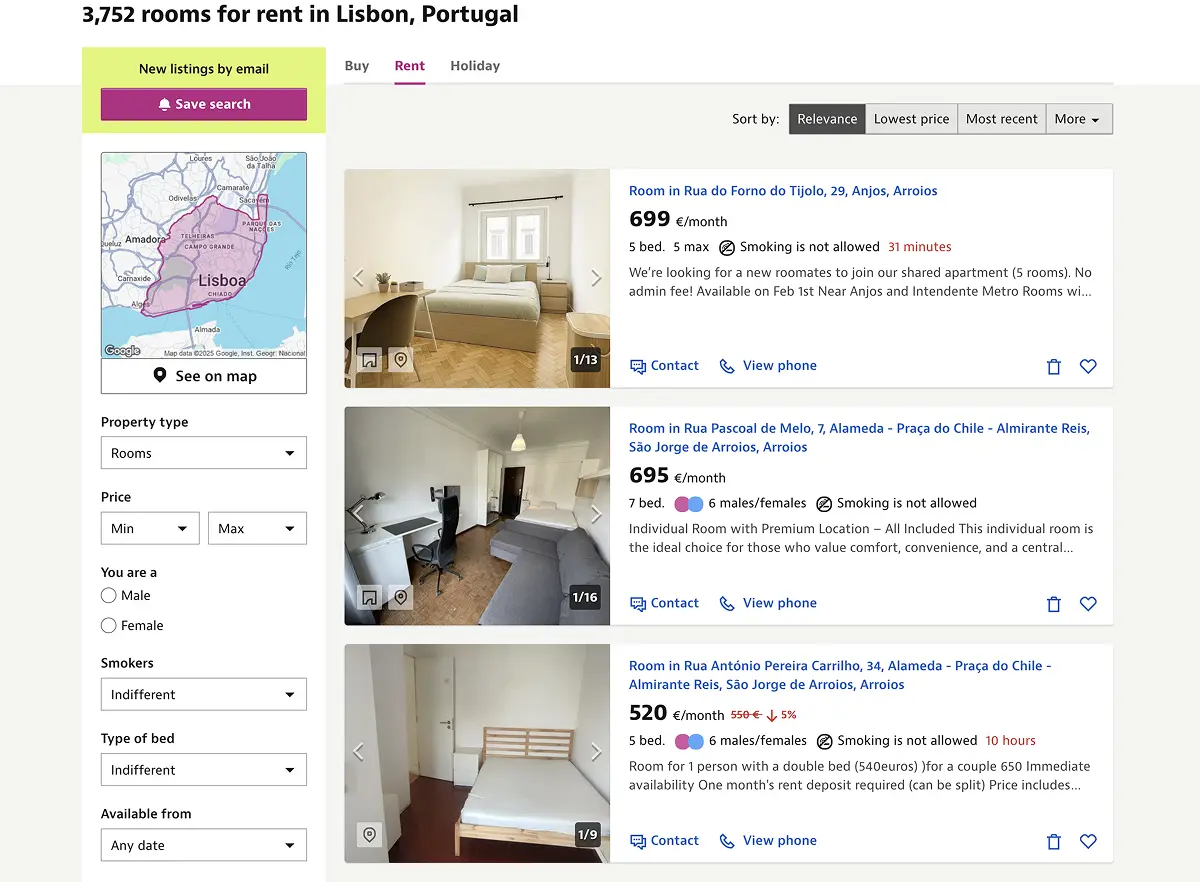
Whatever you choose, always check if the rent includes utilities and condominium fees (condomínio), what the minimum rental period is, how much notice you must give, and whether there is an official, registered contract.
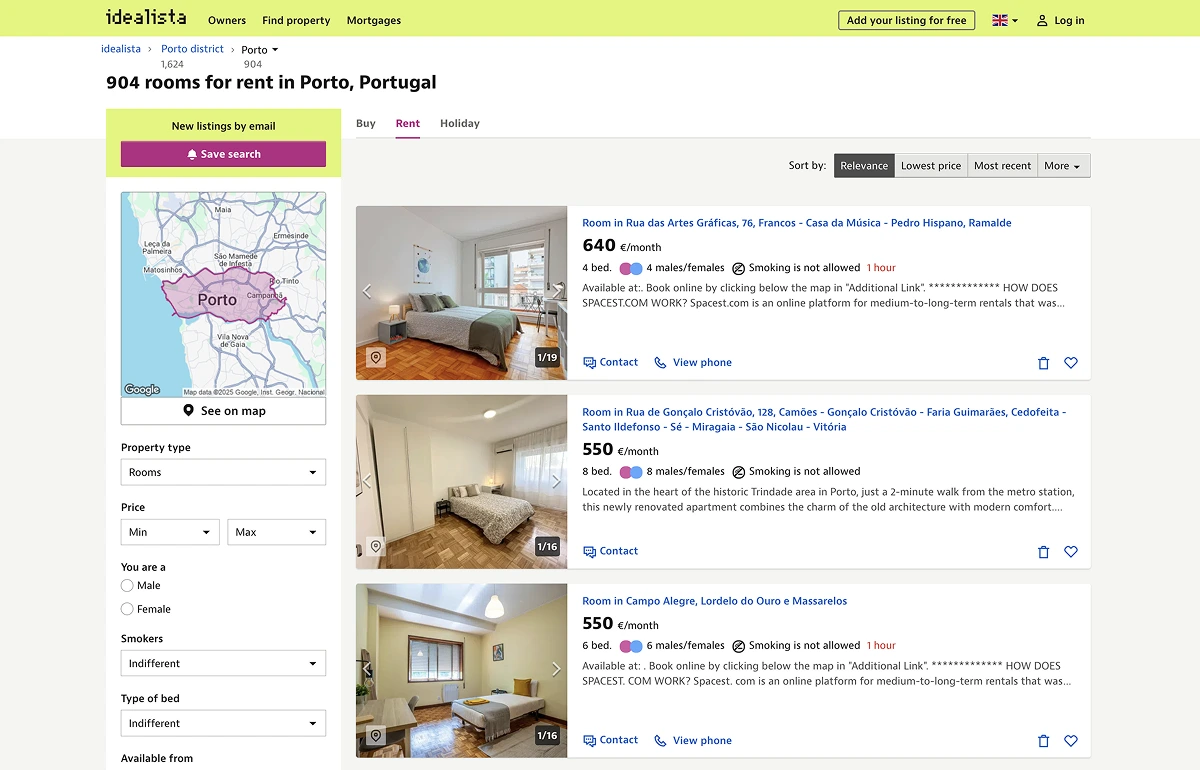
Most students look for housing on platforms like Idealista, Imovirtual, Uniplaces, and on Facebook groups. When using social media, be extra careful. Never send money before you have checked the apartment, met the landlord or agent (online or in person), and seen the contract.
6. Co-living in Lisbon and Porto: Community-Style Housing for Students
If renting a regular apartment feels overwhelming, co-living can be a good middle ground between a student residence and a private flat.
In a typical co-living space, you get a private furnished room (sometimes with your own bathroom) and share kitchens, lounges, and other common areas. Utilities, Wi-Fi, and cleaning of shared spaces are usually included, and some places have coworking areas or community events. This makes it easier to budget and means you don’t have to buy furniture or sign your own contracts.
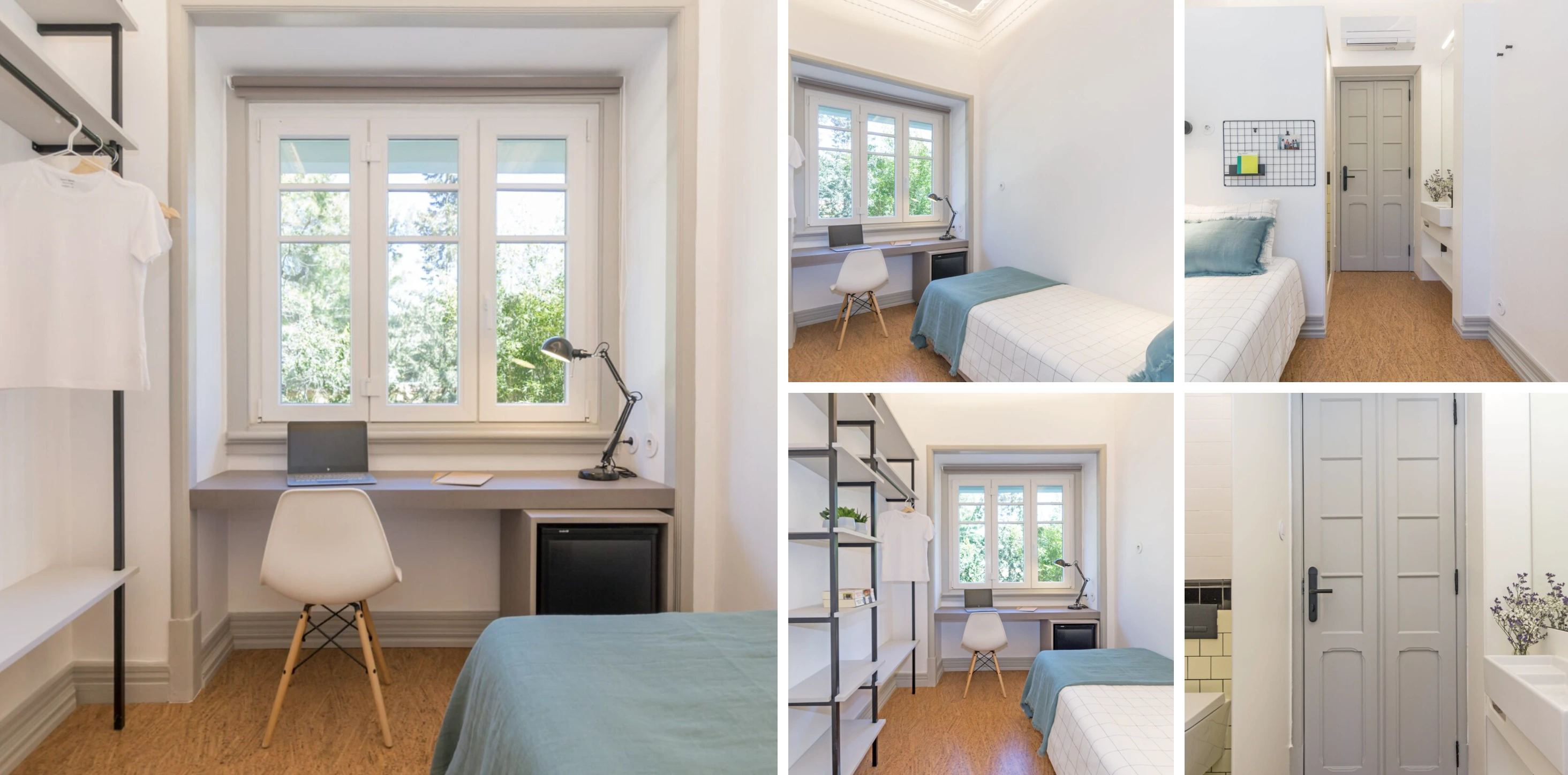
In Lisbon, co-living options range from simple student houses to higher-end spaces with more amenities. In Porto, co-living is often a bit cheaper and sometimes found in creative neighborhoods or near the coast.
Co-living is a good choice if you’re moving alone, want an all-inclusive option, and like the idea of having a community from the start. In the next section, let’s look at where students typically find housing outside the city center.
7. Beyond the City Center: Where Students Actually Live
Most students don’t live on the postcard streets you see on Instagram. Central neighborhoods in Lisbon and Porto are beautiful, but they’re more expensive, busier, and affected by tourism and short-term rentals.

Because of this, many students pick neighborhoods farther out or nearby towns with good public transport. Around Lisbon, places like Almada, Amadora, Oeiras, parts of Loures, and areas between Lisbon and Cascais are popular because they’re more residential and often more affordable, yet still offer reasonable commutes. Cascais and areas near Sintra are chosen more for lifestyle, like being near the ocean or greenery, but this can mean higher prices or longer commutes.
Around Porto, many students live in Vila Nova de Gaia, Matosinhos, Maia, or Gondomar. These areas feel more local and residential, and you can reach the city by metro or bus in about 20-40 minutes.

Some co-living spaces are also outside the city center, especially near the coast, like Costa da Caparica or Matosinhos. These are great if you want more space, easy access to the ocean, or a quieter lifestyle and don’t mind commuting.
Living outside the center usually means lower rent and a more local daily life, but it also means you need to think carefully about transport and commute times. With that in mind, let’s examine how commuting works and the pros and cons of each city’s transport options.
8. Commute, Transport, Pros & Cons
Where you live will have a big impact on how much time and money you spend getting around.
In Lisbon, most public transport, including metro, buses, trams, and some suburban trains, uses the Navegante system. The Navegante Municipal monthly pass (about €30) is valid in one municipality, such as Lisbon city. The Navegante Metropolitano pass (about €40) covers the whole Lisbon metro area, which is useful if you live in places like Almada, Amadora, or Oeiras. One card lets you use almost all types of transport. The downside is that commutes can be long if you live far from the center, and rush hours can be crowded.

In Porto, the transport system uses the Andante card, which works for the metro, buses, and some suburban trains. As of the published Andante tariff, a municipal-style pass is €30 and a metropolitan pass is €40, with other options depending on zones. Many people live in Gaia or Matosinhos and commute by metro. The key is to pick the right zones so your daily routes are included.

For regional and intercity travel, Portugal offers a Green Rail Pass (Passe Verde), it costs €20 for 30 days and allows travel on Regional and InterRegional trains, and in 2nd class between the regions with mandatory free seat reservation. It has limits on some urban segments already covered by Navegante/Andante. For most students, a city transport pass covers daily needs. The rest depends on how far you’re willing to live from campus.

9. Cost of Living Comparison (rent, transport, food, going out)
The general rule is simple: Lisbon costs more than Porto, especially for rent.
In Lisbon, one-bedroom apartments in central areas are much more expensive than in Porto, and the same goes for rooms in shared flats. Porto usually has lower housing costs and gives you more room in your budget, especially if you’re flexible about where you live.
Everyday costs like food, transport, and going out are pretty similar, but Lisbon is usually a bit more expensive overall. A basic meal at a simple restaurant costs about the same in both cities, and cafés, coffee, and student nightlife are also similar, though Porto is a little cheaper.
If you’re on a tight budget, you can usually live more comfortably in Porto for the same amount of money. If you’re willing to pay more for the perks of a capital city, Lisbon might be the better choice.
10. Weather in Lisbon and Porto (and Why It Matters in Winter)
Portugal’s climate is mild, but winter can still catch new students by surprise.
In Lisbon, winter daytime temperatures are usually around 15 to 17°C, and nights rarely drop below 8 to 10°C. Most rain falls between November and February, often as short, heavy showers followed by sunshine. Overall, it feels bright and fairly dry for a European capital.
Porto, which is further north and closer to the Atlantic, is cooler and wetter. Daytime temperatures are usually around 13 to 15°C, and nights can drop to 5 to 7°C. It rains more often, and wind and humidity can make it feel colder than the temperature shows. The weather often feels very “Atlantic,” with clouds, mist, and changing light.
One important detail is heating. Many Portuguese apartments, especially older ones, don’t have central heating. People use electric heaters or air conditioners for warmth, and poor insulation can make rooms feel cold and damp. This happens in both cities, but it’s usually more noticeable in Porto.
As a result, you might sometimes feel colder inside than outside, and your electricity bills can go up in winter. When looking for housing, it’s a good idea to ask about heating, insulation, and windows. With realistic expectations and warm clothes, winter in both cities is manageable. If you’re sensitive to cold and damp, Lisbon may feel more comfortable overall.
11. Career and Networking Opportunities (On-Site and Remote)
Career and networking opportunities are important factors to consider.
Lisbon is one of Southern Europe’s main tech and startup hubs. There are many startups, scaleups, and international companies in tech, fintech, SaaS, digital marketing, UX/UI, and tourism. The city has frequent meetups, conferences, hackathons, and networking events, which is great if you want to be close to a busy professional scene.
Porto’s professional scene is smaller but growing. The city has a strong background in tourism, wine, and hospitality, and there’s more activity now in tech and digital industries. New hubs, incubators, and coworking spaces are opening, so you can build a career while enjoying a quieter lifestyle.
Remote work changes things. Many students in digital fields now work remotely for Portuguese companies, European startups, or even US-based clients, since the time zones are similar. This means you can live in Porto and freelance for a Lisbon agency, or study in Lisbon while working for a remote company somewhere else. Note that international students on a temporary stay visa for vocational courses (E9 visa) do not have the right to work in Portugal.
When planning your career, think about where the offices are, as well as how you want to work: on-site, hybrid, or remote.
12. Free Time: Culture, Ocean, Nightlife, Short Trips
Both cities offer the classic Portuguese mix of ocean, culture, food, and a relaxed social life, just with different levels of energy.
Lisbon has more museums, concerts, international events, and nightlife than any other city in Portugal. There’s almost always something going on, from exhibitions to rooftop parties. Beaches like Carcavelos and Costa da Caparica are about 30 to 40 minutes away by train or bus. The downside is that central neighborhoods can be crowded with tourists all year.
Porto has its own charm, with a historic center, the Douro riverfront, port wine cellars, viewpoints, and a slower pace. Beaches in Matosinhos and along the coast are easy to reach by metro or bus, and the nightlife is smaller but feels more personal.
The good news is you don’t have to choose forever. It’s easy to travel between Lisbon and Porto for weekends or events. Fast trains between Lisboa Oriente or Santa Apolónia and Porto Campanã take about 2 hours and 45-50 minutes. Buses take around 3 hours and 15 minutes (fastest services) and can be very cheap if you book early. Hostels and budget hotels in both cities make short trips affordable, so you can live in one city and still visit the other often.
13. How to Choose: Checklist & Questions to Ask Yourself
If you’re choosing between Lisbon and Porto, these questions can help you figure out your priorities:
- Budget & housing: What is your realistic monthly budget? Are you happy in a room in a shared flat or co-living, or do you need more privacy? Are you open to living just outside the city and commuting?
- Commute & logistics: How much time are you willing to spend on public transport each day? Will a monthly Navegante (Lisbon) or Andante (Porto) pass fit comfortably into your budget? If you are a non-EU student, ensure you apply for the correct visa abroad; for vocational courses, this is typically the E9 temporary stay visa, which allows a stay of up to one year but does not lead to a residence permit or allow local work.
- Career & work style: Do you want frequent in-person meetups and events (more concentrated in Lisbon), or will you mainly work remotely for your home country clients, where a stable internet connection and a quiet workspace matter more than the city itself?
- Lifestyle & vibe: Do you enjoy big-city buzz and constant events, even with crowds and higher noise levels (Lisbon)? Or do you prefer a calmer rhythm and a strong local feel (Porto)?
- Travel & flexibility: How important is it for you to explore the rest of Portugal during your studies? Would you be happy living in one city and regularly visiting the other by train or bus?
Your answers won’t point to a “perfect” city, but they usually make one option feel like a better fit for how you want to live and study right now.
14. Conclusion
There isn’t one city that’s better for everyone. The best choice is the one that matches your priorities and supports the student life you want.
Pick Lisbon if you want the energy of a capital city, can handle higher housing costs, and like being close to lots of companies, events, and communities. Pick Porto if you prefer a slower pace, lower rent, and a cozy atmosphere, while still having access to tech, creativity, and the ocean.
No matter which city you choose, you can live in the center or in nearby towns, use monthly transport passes to manage your budget, and work on-site or remotely if your visa status allows (European students only). Traveling between Lisbon and Porto only takes a few hours, and in both places you’ll find a welcoming student community and plenty of chances to grow, explore, and enjoy your time in Portugal.
15. Useful Links
Accommodation search
- Idealista – apartments and houses:
https://www.idealista.pt - Imovirtual – listings for Lisbon, Porto, and beyond:
https://www.imovirtual.com - Uniplaces – student rooms and flats with online booking:
https://www.uniplaces.com
Local transport cards
- Navegante (Lisbon area – monthly passes and info):
https://www.navegante.pt - Metro Lisboa (maps, tickets, timetables):
https://www.metrolisboa.pt/en - Andante (Porto area – cards and passes):
https://www.andante.pt/en
Trains and Green Pass
- Comboios de Portugal (CP) – national trains, timetables, tickets:
https://www.cp.pt - Passe Ferroviário Verde (Green Rail Pass) – official information:
https://www.cp.pt/info/w/passe-verde
Intercity buses (Lisbon–Porto and beyond)
- FlixBus Portugal – low-cost intercity buses:
https://global.flixbus.com - Rede Expressos – national bus network:
https://rede-expressos.pt