Portugal Student Visa vs D7 Visa: Which Route Fits Better?

If you are comparing portugal student visa vs d7 visa, the real question is usually simpler: do you want residence in Portugal because you already have passive income, or because you want to study, build local ties, and move into the job market step by step? In Lisbon, Porto, Coimbra, and Braga, those two routes lead to very different paperwork, timelines, and day-to-day realities. We see this often at Facultét: people arrive thinking the visa choice is mostly legal, then discover it shapes housing, banking, work options, and even how quickly they settle in.
Portugal student visa vs D7 visa: the difference in one paragraph
The student visa is designed for people enrolled in a recognised educational programme in Portugal. The core of the application is your admission letter, proof of funds, accommodation, insurance, and a clean criminal record. The D7 visa is for applicants with stable passive income, typically from pensions, rents, dividends, or similar sources. The centrepiece there is not school admission but income evidence that shows you can live in Portugal without relying on local employment. Both can lead to residence permits, but they serve different life plans.
That distinction matters in practice. A student in Coimbra may be renting a room near the university zone and planning classes, language study, and part-time work. A D7 applicant in Porto, perhaps in Cedofeita or Bonfim, is usually proving recurring income and preparing for a more financially self-supported move.
Who usually qualifies for each visa?
Student visa: best for structured study and a gradual move
You normally apply for a Portuguese student visa when you have been accepted by a higher education institution, a recognised professional training provider, or another eligible study programme. The Portuguese immigration portal is now under AIMA, while visa applications abroad are commonly handled through Portuguese consulates or VFS Global, depending on the country.
For professional training, recognition of the school matters. In Portugal, DGERT certification is a serious credibility marker for non-higher-education training providers. If your goal is to study with a school that is established in the Portuguese training ecosystem, that detail is not cosmetic; it affects how your course is perceived by employers and, in some cases, how confidently you prepare your file.
D7 visa: best for passive-income holders
The D7 route generally suits retirees, landlords, people living on investment income, or families supported by steady recurring funds from abroad. If your income depends on active remote work for clients or an employer, D7 can become a greyer area. Some applicants still use it, but the cleaner fit for remote workers is often the D8 digital nomad visa, which has its own threshold and documentary burden.
That is one reason the comparison is often not just student visa vs D7. It is also a comparison between study-based entry and the digital nomad route. And if we are being candid, many applicants overestimate how simple D8 is in real life.
How much money do you need for Portugal in 2026?
Budgets change by city. Lisbon is the most expensive, Porto follows, while Coimbra and Braga are usually easier on rent. The legal proof-of-funds amount depends on the visa category and current official reference values, so always cross-check with the Portuguese consulate and AIMA. For broader planning, these working numbers are more useful.
| City | Room in shared flat | 1-bedroom flat | Monthly living costs excl. rent |
|---|---|---|---|
| Lisbon | €450-€800 | €1,100-€1,800 | €550-€800 |
| Porto | €400-€700 | €900-€1,400 | €500-€750 |
| Coimbra | €250-€450 | €600-€900 | €450-€650 |
| Braga | €300-€500 | €650-€950 | €450-€650 |
These are market ranges based on current listings and cost-of-living benchmarks such as Numbeo, then adjusted by what students and recent arrivals actually report to schools and relocation advisers. Alfama and Arroios in Lisbon, for instance, can differ sharply by flat condition and contract length. In Porto, Cedofeita is rarely the cheapest option, while Paranhos may offer better value for students.
For D7, the financial bar is usually felt much more heavily because you need to demonstrate sustainable income, not just a study plan and enough funds for the initial period. For students, the budget can be tighter, but that does not mean cheap. Housing is the pain point.
Can you work on a student visa or D7 visa?
In many cases, yes, but the scope and logic differ.
- Student residence may allow work, subject to current immigration rules and the type of permit issued. The main basis of stay remains study.
- D7 residence is not a work visa either, but D7 residents can generally engage in professional activity once resident, because they are lawful residents in Portugal.
The better question is what path makes employers more comfortable. On the ground, Portuguese employers care less about the visa label than about whether your residence status is regular, your Portuguese or English level is usable, and your profile matches a role.
In Lisbon and Porto, international employers such as Siemens, Bosch, Revolut, Natixis, Farfetch, BNP Paribas, Sonae, Critical TechWorks, and Feedzai often hire foreigners. Entry-level salaries vary a lot, but for junior business support, digital marketing, customer operations, or project coordination roles, gross monthly pay often lands around €1,000 to €1,500. Skilled tech roles can be higher, of course. Net pay depends on tax status and household situation. For national wage trends, Pordata remains one of the most reliable public references.
Why study can be a stronger route than the digital nomad visa
This is where many people change their mind. The D8 digital nomad route sounds attractive because it appears direct: keep your foreign income, move to Portugal, carry on. Yet in practice, it often creates a thin connection to the local market. You may have residency, but not a Portuguese network, not a local credential, and not much reason to improve your Portuguese beyond survival level.
A study-led move is slower, but usually stickier. You build references in Portugal, understand workplace norms, and get used to everyday bureaucracy: NIF, NISS, bank account, local address proof, tax portal, health registration. That matters more than glossy visa comparisons suggest.
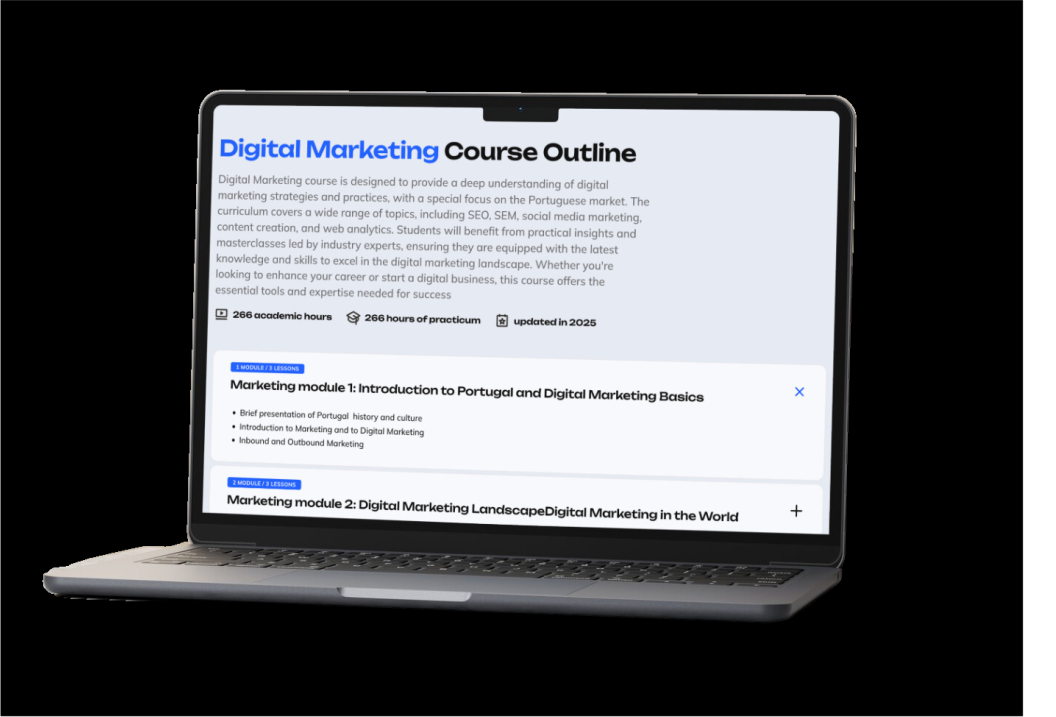
By our experience, students who come through training adapt faster when they want to pivot careers in Portugal. A professional course in areas like Digital Marketing or Project Management gives them a timetable, peers, practical assignments, and often the first credible local line on a CV. For career changers, that is not a small advantage.
There is another point people miss. D8 applicants are tied to income thresholds and document consistency from foreign clients or employers. If a contract ends at the wrong time, anxiety arrives quickly. Students usually have a different pressure profile: lower income expectations at entry, but more work to do in terms of planning the transition into employment.
What documents are usually required?
Student visa file
- Acceptance or enrolment letter from the Portuguese institution.
- Proof of accommodation in Portugal.
- Proof of funds for tuition and living costs.
- Health insurance, if required by the consulate.
- Criminal record certificate, legalised where necessary.
- Passport and visa application forms.
Once in Portugal, many students also need to sort out NIF, sometimes NISS later, and address proof such as an atestado de residência from the local Junta de Freguesia if a standard tenancy contract is not enough.
D7 visa file
The D7 packet includes many of the same basics, but swaps school admission for income proof. Expect to show bank statements, evidence of recurring passive income, accommodation, insurance, and a tax or pension paper trail that actually makes sense to the officer reading it. Gaps and vague explanations are where delays often begin.
Processing times vary by country and season. A consular phase may take several weeks to a few months. After arrival, permit issuance and follow-up steps can add more time. Anyone promising a neat fixed number of days is overselling certainty.
Recognition of diplomas: when does equivalence matter?
If you plan to continue to regulated higher education or use an academic degree from abroad in a formal Portuguese process, diploma recognition may matter. Portugal uses the system of reconhecimento and equivalência through higher education institutions and the DGES framework. That is separate from DGERT certification, which concerns the training provider rather than university degree equivalence.
People often mix these up. A foreign bachelor’s degree may require recognition for certain pathways. A professional training course from a DGERT-certified school is a different animal: useful for employability and skills, but not the same as converting a foreign university diploma into a Portuguese degree equivalent.
Two common scenarios we see with international students
One typical case is a 30-something remote worker who can meet D8 income rules but wants to stay in Portugal long term and eventually work locally. On paper, D8 looks tidy. In reality, after six months in Lisbon, they realise their network is still mostly online and foreign. A study route would have given them local references, classmates, and a reason to interact with employers.
Another pattern is a family-supported student moving to Porto or Braga to retrain. The budget is tighter than on D7, yes, but the pathway is clearer: arrive legally for study, settle in, improve language skills, complete a course, and then test the Portuguese market from inside the country. We in Facultét see that this route often suits career changers better than they expected at the start.
Which route is better for life in Lisbon, Porto, Coimbra, or Braga?
Lisbon offers the largest job market and the highest rent. It suits applicants who need international employers and can absorb housing costs.
Porto is often the best middle ground: strong business activity, a serious tech and services scene, and slightly lower living costs than Lisbon.
Coimbra remains the classic student city. If your priority is study culture and a more manageable budget, it deserves attention.
Braga works well for applicants who want lower costs, a growing economy, and a calmer pace. It is not sleepy anymore, but it is still more breathable than Lisbon.
Culturally, Portugal rewards patience. Appointments shift, documents get requested twice, and landlords may prefer tenants with Portuguese guarantors. Speaking even basic Portuguese changes the tone of many interactions. If you arrive on D7 or D8 without that local integration piece, daily friction feels sharper.
So, portugal student visa vs d7 visa: which one should you choose?
Choose the student visa if your main asset is motivation to study, retrain, and build a life in Portugal through education and local experience. Choose the D7 visa if you already have robust passive income and do not need study as your legal basis for residence. If your real plan is remote work, compare D8 too, but do not assume it is automatically the smartest route.
For many career changers, study is the more grounded choice. It gives structure, credibility, and a reason to plug into Portuguese life beyond renting a flat and opening a bank account. If Portugal is more than a temporary base for you, that difference tends to show up quickly.
If you are weighing a study-led move to Portugal and want a practical route into the local market, look at Digital Marketing, Project Management, or contact us via /contact to discuss which training path fits your visa plan and career timeline.
Часто задаваемые вопросы
Is the D7 visa easier than the student visa?
Not necessarily. D7 can look simpler because it does not require admission to a school, but the financial proof is often stricter in practice. If your passive income is strong and well documented, D7 may be smoother. If it is patchy or depends on active work, the case becomes harder.
Can I switch from a student route to work later in Portugal?
In many cases, yes, depending on your residence status, the job offer, and the rules in force at the time. This is one reason study can work well for people planning a longer relocation rather than a short stay.
Why choose study in Portugal instead of the digital nomad visa?
Study usually gives better local integration: classmates, teachers, projects, a Portuguese CV line, and a routine inside the country. Digital nomad status is useful for some profiles, but it does not automatically help with changing careers or entering the local labour market.
How much does it cost to live in Portugal as a student?
In 2026, many students need roughly €800 to €1,600 per month depending on city and housing. Coimbra and Braga are usually cheaper; Lisbon is the hardest on rent.
Do I need diploma recognition to study or work in Portugal?
It depends on the programme and profession. Academic degree recognition through DGES may be necessary in some cases, especially for regulated paths. For professional training, the school’s DGERT certification is a separate issue and often more relevant than degree equivalence.