Portugal Job Seeker Visa vs Student Visa: Which One Actually Gets You There?


You've been reading about Portugal for months. The LinkedIn posts, the Reddit threads, the Instagram reels of tiled buildings and €3 espressos. You've decided: you're going. But then you open a government website and everything falls apart. Job Seeker Visa. Student Visa. D4. D1. Article 57-A. Article 122. IEFP. AIMA. It feels like you need a law degree just to pick the right visa.
Here's what nobody says clearly: Portugal changed the rules in September 2026. The old Job Seeker Visa — the one that let almost anyone come and look for work — doesn't exist anymore. What replaced it is stricter, more selective, and aimed at a specific group of people. Meanwhile, the Student Visa (D4) for higher education remains a way to get into Portugal, while professional training now falls under the E9 temporary stay visa.
Let's break down both options, side by side, so you can actually make a decision.

What happened to the Job Seeker Visa in 2025?
The original Job Seeker Visa launched in June 2022. The idea was simple: come to Portugal for 120 days, find a job, convert to a residence permit. It was open to pretty much anyone — skilled, semi-skilled, it didn't matter much. Thousands applied.
Then came Law No. 61/2025, effective October 23, 2025. The Portuguese government cancelled the old visa entirely. Consulates stopped accepting applications overnight. Existing appointments were voided. In its place: the Skilled Job Seeker Visa (officially: Visto de Procura de Trabalho para Profissionais Altamente Qualificados).
The difference isn't subtle. The new visa is explicitly for highly qualified professionals — people with university degrees and at least five years of relevant experience. If you're 24 years old with a fresh bachelor's and no work history, this visa is no longer for you.
So what exactly does the Skilled Job Seeker Visa require now?
Let's go through the checklist.
Qualifications: You need a university or technical degree (bachelor's, master's, or PhD) plus at least 5 years of professional experience in your field. Both are mandatory. Your degree and experience must demonstrate what the law calls "a high level of competence, technical knowledge, and professional skill."
IEFP Registration: Before you apply at the consulate, you must submit an Expression of Intent to IEFP (Instituto do Emprego e Formação Profissional — Portugal's public employment service). This is a pre-requisite, not the visa itself. You get a confirmation email, and only then can you proceed with the actual visa application.
Financial proof: At least 3× the Portuguese minimum wage, which in 2026 means €2,760 in your bank account (3 × €920). This requirement can be waived if a Portuguese citizen or legal resident signs a term of responsibility covering your food, accommodation, and repatriation.
Other documents: Valid passport, apostilled criminal record, health insurance covering your entire stay, return ticket, a statement describing your planned stay conditions.
Duration: 120 days, extendable once for 60 more days. Total maximum: 180 days (6 months).
Entry: Single entry only. Once you leave Portugal, the visa is done.
Family: Your family members cannot accompany you on this visa. No family reunification option.
Schengen travel: Not allowed. The visa only authorizes stay in Portugal — you can't hop to Spain or France for a weekend.
Processing time: Around 20 working days in 2026 (faster than before). The government moved the entire process online starting January 2026.
Cost: ~€90 for the visa application + €170 for the residence permit if you find a job.

What happens if you find a job? Or if you don't?
If you secure a position that matches your qualifications, you apply for a Residence Permit for Highly Qualified Activity under Article 77. Your visa already includes a pre-scheduled AIMA appointment, which makes the transition smoother. Once hired, the conversion to a residence permit is direct — no need to leave Portugal.
The industries where people find work fastest? IT averages about 61 days from arrival to signed contract. Engineering: 64 days. Healthcare: 72 days.
If you don't find a job within 180 days, you must leave Portugal. You can reapply for the same visa, but only after a one-year waiting period. There's no extension beyond the 180 days.
Now let's look at the Student Visa (D4) and Training Visa (E9)
The D4 visa is Portugal's long-term residence visa for non-EU citizens who are enrolled in higher education. Since September 2026, vocational training courses (including DGERT-certified) now fall under the E9 Temporary Stay Visa under Article 54(1)(k).
Here's what you need for a training course:
Enrollment: An acceptance letter from a recognized Portuguese educational institution — such as an accredited DGERT vocational school.
Financial proof: Approximately €920/month (1× minimum wage). A sponsor can also provide a letter of financial support.
Other documents: Valid passport, criminal record certificate, health insurance, proof of accommodation.
Duration: The E9 visa is valid for the duration of the course up to 1 year. It allows multiple entries but does not lead to a residence permit or count toward citizenship.
Work rights: The E9 visa does not carry the right to work in Portugal.
Family: No — family reunification is not available for temporary stay visas like the E9.
Schengen travel: Limited to short visits, but the primary purpose must be the stay in Portugal.
Cost: ~€75 for the visa.
Processing time: Up to 30 days for a consular decision.
The part nobody talks about: what happens after graduation
This is where the higher education D4 visa remains powerful, whereas vocational training has become a temporary stay.
Under current law, only university students can switch directly to a work permit from within Portugal. For those on an E9 vocational training visa, the stay is strictly temporary. You must apply for a residence visa from abroad if you wish to return for work later.
For university graduates, time spent on a student residence permit counts toward the 5-year requirement for permanent residency and Portuguese citizenship. However, time spent on an E9 visa for vocational training does not count toward residency or citizenship.
Side-by-side comparison
Here's everything in one place:
Skilled Job Seeker Visa:
Duration: 120 + 60 days (max 6 months). Who can apply: degree + 5 years experience. Financial requirement: €2,760 (3× minimum wage). Work: yes, during visa validity. Family: no. Schengen travel: no. Path to residency: if hired → residence permit. If it doesn't work out: must leave, 1-year reapply wait.
Vocational Training (E9):
Duration: length of course (max 1 year). Who can apply: anyone accepted into DGERT institution. Financial requirement: ~€920/month. Work: No. Family: no. Schengen travel: yes (short stay). Path to residency: None (does not lead to permit). Path to citizenship: does not count toward 5-year requirement. Entry type: multiple entries.
When does the Job Seeker Visa make sense?
It's not a bad visa — it's just a very specific one. The Skilled Job Seeker Visa works best if you're an experienced professional (5+ years in IT, engineering, healthcare, or other shortage sectors) with a degree that's easy to validate internationally. You've already been networking with Portuguese companies remotely and have warm leads. You want to move fast — arrive, interview face-to-face, sign a contract, convert to a residence permit. You don't need to bring family in the first six months. And you have at least €2,760 available to show at the consulate.
When does the Training Visa (E9) make sense?
For those looking to gain specific skills in a short timeframe, the E9 visa for vocational training is the correct route.
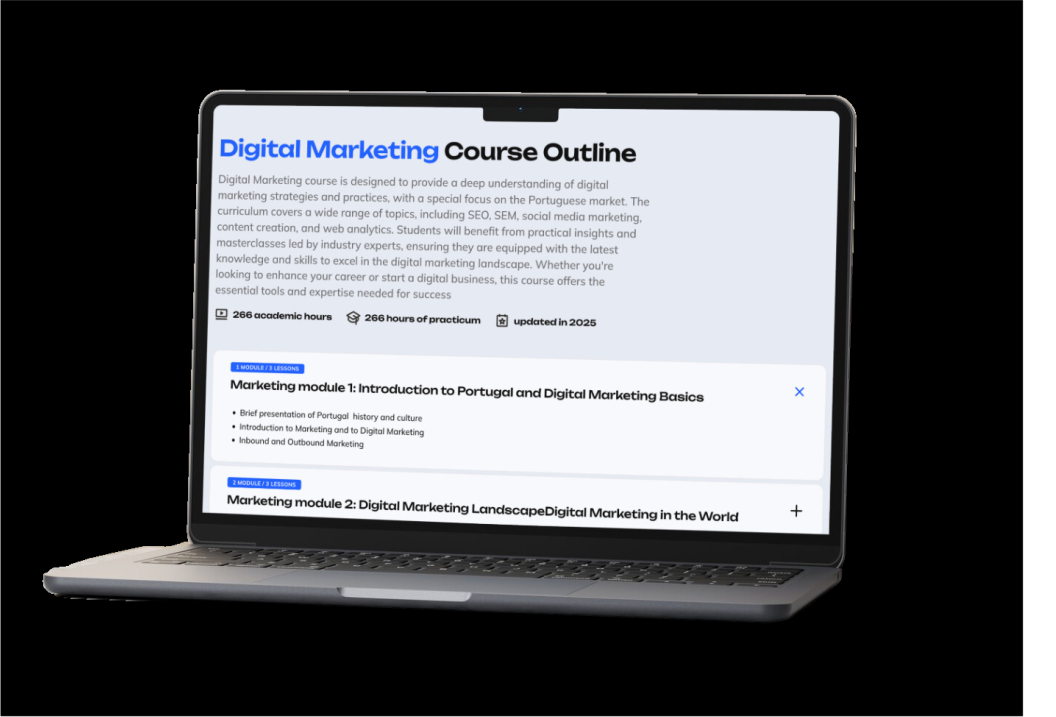
You want to gain a European qualification in fields like digital marketing, project management, data science, or design. You want to understand the Portuguese market while you study. You understand that this is a temporary stay to build your CV before seeking a work visa from your home country later. You have the means to support yourself without working during your studies.
A note on DGERT certification — and why it matters for visas
DGERT (Direção-Geral do Emprego e das Relações de Trabalho) is the Portuguese government body that certifies training institutions. When your school is DGERT-certified, your course enrollment is recognized by immigration authorities as valid for a visa.
At Facultét, for example, courses run on an evening schedule (2 evenings per week, 2–3 hours each). While these programs provide high-level training, since September 2026, students must obtain an E9 temporary stay visa from their local consulate before traveling to Portugal.
Your decision framework
Still not sure? Here's a simple way to think about it.
Go with the Job Seeker Visa if: you're 30+, have a degree and 5+ years of relevant experience, are targeting a specific industry in Portugal, and are comfortable with a tight 6-month timeline.
Go with the Training Visa (E9) if: you want to study at a vocational school, can support yourself without working, and are looking for a temporary stay to gain skills.
One more thing: the bureaucracy doesn't stop at the visa
Whichever path you choose, you'll need a NIF (tax number), a NISS (social security number), and a Portuguese bank account. Consulates have their own quirks, and the E9 must be obtained in your country of origin.
The best thing you can do is start early, keep your documents organized, and have a clear plan. The visa is just the door. What matters is what you build after you walk through it.
FAQ
Can I switch from a Job Seeker Visa to a Student Visa?
They're separate visa types with separate applications. If your Job Seeker Visa expires without employment, you'd need to leave Portugal and apply for the correct visa from your home country (or country of legal residence).
Does the Student Visa (D4) work for vocational courses?
Since the September 2026 law change, Article 92 was amended. Vocational/professional training courses now fall under the E9 temporary stay visa, while D4 is reserved for higher education and secondary education.
How much money do I actually need for each visa?
For the Skilled Job Seeker Visa: at least €2,760 in your bank account (3× minimum wage). For the Training Visa (E9): approximately €920 per month of your stay.
Can I work on a vocational training visa?
No. The E9 temporary stay visa for vocational training (Article 54(1)(k)) does not carry the right to work in Portugal.
What happens if I don't find a job on the Job Seeker Visa?
You must leave Portugal when the visa expires (after a maximum of 180 days). You can reapply, but there's typically a one-year waiting period before you're eligible for the same visa again.
Is the Job Seeker Visa still open for applications in 2026?
The old version was permanently cancelled in October 2025. The new Skilled Job Seeker Visa is active but requires a university degree plus 5 years of professional experience.
Does time on a training visa count toward Portuguese citizenship?
No. Time spent on an E9 temporary stay visa for vocational training does not count toward the 5-year residency requirement for citizenship. Only residence permits count.