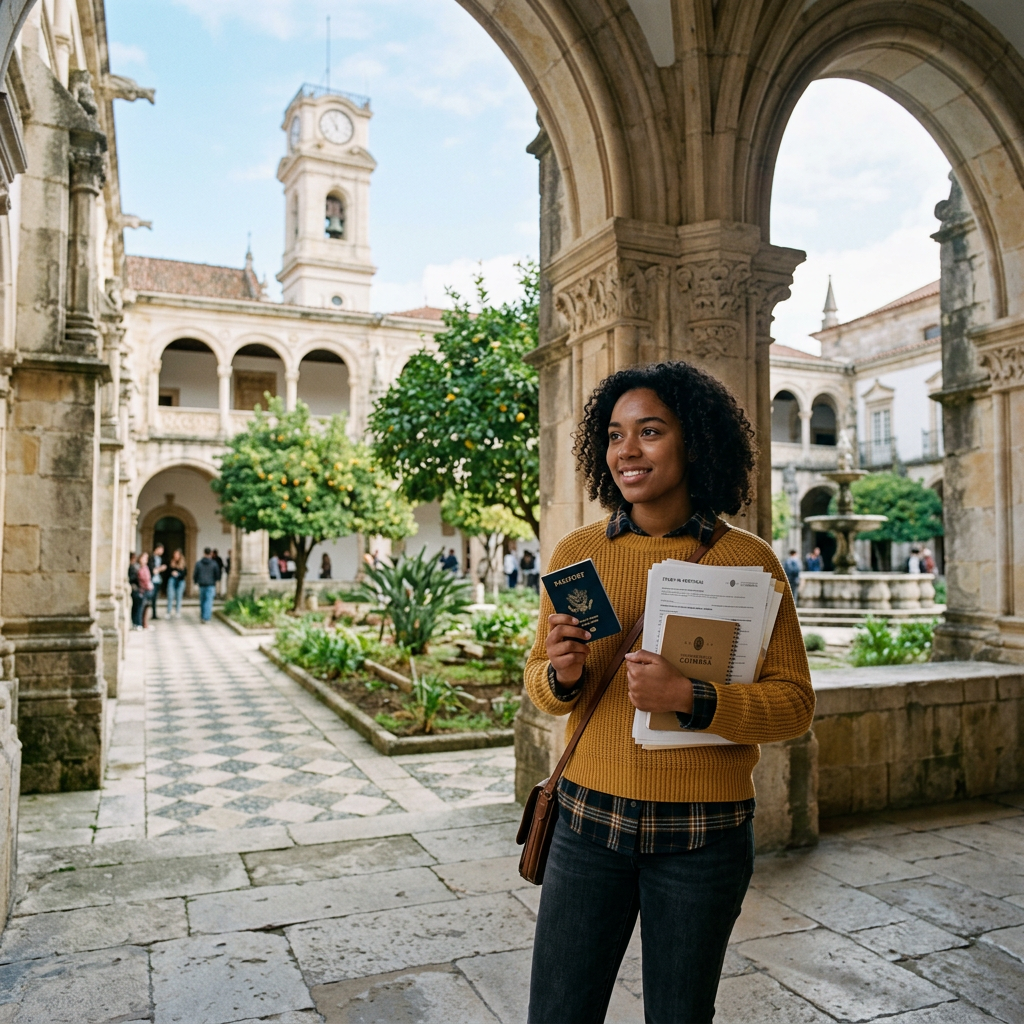
Portugal Residence Permit for Study or Training: 2026 Guide

The Portugal visa options for study or training are one of the most practical legal pathways for non-EU nationals who want to study, join vocational training, or build a career in Portugal. Whether you plan to enroll in higher education, language study, or professional training in Lisbon, Porto, Coimbra, or Braga, the process usually starts with the correct visa. In this guide, we explain the legal route, expected costs in EUR, DGERT and IEFP context, renewal rules, and what to know about renewals in real-life immigration situations.
What is the Portugal visa and permit for study or training?
Portugal allows third-country nationals to live legally in the country for educational purposes, including:
- Higher education studies (Article 91)
- Secondary education (ensino secundário)
- Professional qualification and vocational training (Temporary stay visa E9)
- Student exchange or mobility schemes
- Internships linked to training
- In some cases, preparatory or supplementary study pathways
Under the September 2026 legal changes, the route depends strictly on the level of study. Residence permits are reserved for higher education and secondary education via a residence visa. Vocational/professional training (DGERT/QNQ 4/5) now follows the E9 temporary stay visa route. In 2024-2026, the institutional transition from SEF to AIMA changed administration, so applicants should always verify current procedures through official channels.
Key official sources include:
Who can apply?
You may qualify if you are a non-EU/EEA/Swiss citizen and have been accepted into a legitimate educational or training program in Portugal. The institution and course matter. For vocational and professional training, applicants should prioritize providers with a clear legal framework and recognized quality standards. In Portugal, DGERT certification is a strong quality signal for training entities, and IEFP recognition is especially relevant in the employment and training ecosystem.
For example, if your goal is practical upskilling in a modern field, a structured professional course such as Digital Marketing, Project Management, or Data Science - Machine Learning & AI may align with the “training” route when supported by the correct admissions and documentation. However, visa eligibility always depends on the legal nature of the program and the documents provided to the consulate.
Study vs training: what is the difference?
In practice, applicants often confuse academic study with vocational or professional training. Portuguese authorities assess the purpose of stay carefully.
Study
- Usually linked to universities or polytechnic institutes (Residence Permit Article 91) or secondary education (Article 92)
- Includes bachelor’s, master’s, PhD, exchange, or recognized academic mobility
- Common cities: Lisbon, Porto, Coimbra
Training
- Usually linked to professional qualification, technical learning, or skills development (Temporary Stay Visa E9)
- Should be documented with enrollment from a DGERT-certified or recognized provider
- Stay is limited to one year and does not lead to a residence permit or citizenship
If you are searching in Russian for профкурсы в португалии купить, the key point is not simply “buying a course.” For immigration purposes, the course must be legitimate and the applicant must apply for the correct visa abroad. Since 2026, legalisation from inside Portugal is restricted to specific academic cases like secondary education.
Main visa route
Most applicants need to apply from their country of residence for the appropriate entry visa. The exact visa type depends on course duration and purpose.
Common pathways
- Residence visa for study – for long-term academic or secondary study in Portugal leading to a residence permit.
- Temporary stay visa (E9) under Article 54(1)(k) – for vocational and professional training courses. This allows stays up to one year but carries no right to work or permanent residency.
Documents usually required
Requirements vary by consulate and applicant profile, but the following are commonly requested:
- Valid passport
- Visa application form
- Passport photos, if requested
- Acceptance letter or enrollment certificate (DGERT-certified for training)
- Proof of tuition or training fee payment, where applicable
- Proof of accommodation in Portugal
- Proof of sufficient financial means
- Health insurance or PB4, when accepted for eligible nationals
- Criminal record certificate from country of residence
- Consent for Portuguese criminal record check
- Travel itinerary in some cases
Always check the Portuguese consular guidance on vistos.mne.gov.pt because local consulates may ask for additional evidence.
How much money do you need?
Budgeting is essential. Portugal remains more affordable than many Western European destinations, but prices differ by city.
Typical monthly living costs in 2026
| City | Shared room | Studio/1-bed | Food | Transport | Total monthly estimate |
|---|---|---|---|---|---|
| Lisbon | EUR 450-750 | EUR 900-1,400 | EUR 220-320 | EUR 40-60 | EUR 900-1,700+ |
| Porto | EUR 350-650 | EUR 750-1,150 | EUR 200-300 | EUR 35-50 | EUR 800-1,450+ |
| Coimbra | EUR 250-450 | EUR 550-850 | EUR 180-280 | EUR 25-40 | EUR 650-1,150+ |
| Braga | EUR 250-450 | EUR 550-850 | EUR 180-280 | EUR 30-40 | EUR 650-1,150+ |
Training or tuition costs vary widely:
- Short professional courses: from a few hundred EUR to several thousand EUR
- Private specialized programs: often EUR 1,500-6,000+
- Public higher education: usually lower than many EU peers, but depends on level and institution
Applicants should also plan for:
- Visa fees
- NIF and bank setup costs, if relevant
- Deposit plus first rent payment
- Books, software, and equipment
DGERT and IEFP: why they matter
For vocational education and professional training in Portugal, provider credibility is not a minor detail. DGERT certification confirms that a training entity meets recognized quality standards. For those on an E9 visa, DGERT certification is a requirement for the visa application under Article 23-B of Decreto Regulamentar 4/2022.
This matters for three reasons:
- Immigration compliance: recognized training is a prerequisite for the E9 temporary stay visa.
- Employability: employers in Portugal better understand the value of structured, quality-assured training.
- Academic/professional progression: in some cases, recognition pathways are easier when the training background is transparent and formalized.
Residence permit vs. Temporary stay
Once in Portugal, students in higher education with a residence visa complete the residence permit process with AIMA. However, trainees on an E9 visa do not receive a residence permit; they remain on a temporary stay status for up to one year, which can be extended once under Article 72 but does not count toward residency time for citizenship.
In practice, for those eligible for a permit you may need:
- Your passport and visa
- Appointment confirmation, if applicable
- Enrollment proof updated for the current period
- Address proof in Portugal
- NIF in some practical situations
- Evidence of means of subsistence
- Proof of social security or health coverage, depending on the case
Can you work with a study or training visa?
Students in higher education holding a residence permit may generally perform professional activity. However, holders of the E9 temporary stay visa for professional training are NOT authorized to work under the 2026 regulations.
Portugal’s labor market is strongest in:
- Tourism and hospitality
- Customer support and shared service centers
- IT, software, data, and digital roles
- Marketing and e-commerce
- Construction, logistics, and some technical trades
Recognition of diplomas and equivalence in Portugal
If your plan includes continuing education or regulated professional work, diploma recognition may become necessary. In Portugal, foreign diplomas may require recognition/equivalence depending on the purpose:
- Academic continuation
- Public-sector applications
- Regulated professions
The process depends on the level and country of origin. Universities and DGES-related procedures are often involved for academic recognition. Do not assume that a foreign diploma is automatically accepted in Portugal.
Renewal and “92 статья продление внж”
Many Russian-speaking users search for 92 статья продление внж. Following the 2026 reform, Article 92(4) was revoked, meaning vocational training no longer leads to a residence permit. Renewal under Article 92 is now restricted to secondary education students. For trainees on an E9 visa, extensions are possible up to a maximum of one year total, after which the holder must depart.
From a practical perspective, for renewal you should prepare early:
- Renew enrollment before the stay expires.
- Collect attendance and payment records.
- Keep your address registration and rental proof updated.
- Monitor official notices from AIMA about automatic extensions or appointment procedures.
Do not rely on social media summaries alone. Immigration backlogs have created confusion, and outdated advice can be risky.
Alternative visas people compare with study or training
Some applicants are unsure whether study/training is the best route, especially if they already have income or remote work.
D7 visa
Usually for those with passive or stable recurring income, such as pensions, rentals, or dividends.
D8 visa
Typically used by remote workers and digital nomads with qualifying income.
Student visa
The direct route for academic study leading to residency.
Job seeker visa
Designed for entering Portugal to look for work under specific conditions.
Cultural realities of studying in Portugal
Portugal is welcoming, but adaptation still matters. International students and trainees should expect:
- A slower administrative pace than in Northern Europe
- High pressure in urban housing markets, especially Lisbon and Porto
- Polite but formal communication in official settings
- Strong value placed on punctual documents, even if appointments run late
- Better integration outcomes when you learn basic Portuguese, even in English-speaking programs
Best practices before you apply
- Choose a legitimate institution or training provider (DGERT-certified).
- Confirm whether the program leads to a residence permit (academic) or a temporary stay (E9 training).
- Prepare funds for at least 6-12 months of realistic expenses.
- Secure accommodation early.
- Check official visa instructions from the Portuguese consulate serving your residence country before traveling.
- Keep scanned copies of every submission and payment.
If your objective is career-oriented training in Portugal, selecting a practical program can make the move more valuable professionally. For example, structured learning in analytics, project delivery, or digital business can support later employability, though the E9 visa itself is for study only.
For tailored guidance on training options, you can explore Facultét programs or contact the school to understand which pathway best fits your goals and documentation needs.
Часто задаваемые вопросы
Can I get a Portugal residence permit for a professional training course?
No. Under the 2026 legal update, vocational and professional training courses lead to an E9 temporary stay visa, not a residence permit. Only higher education and secondary education qualify for residence permits.
How much money do I need to live in Portugal as a student or trainee?
A realistic minimum is often around EUR 650-1,150 per month in Coimbra or Braga and EUR 900-1,700+ in Lisbon, depending mainly on rent. Tuition or course fees are additional.
What does 92 статья продление внж usually refer to?
It refers to residence permit renewal. Note that Article 92(4) regarding vocational training was revoked; it now applies only to secondary education. Trainees must use the E9 extension process.
Is a DGERT-certified training provider better for immigration purposes?
DGERT certification is mandatory for those applying for the E9 temporary stay visa for professional training under current Portuguese regulations.
Can I work in Portugal while holding a training visa?
No. The E9 temporary stay visa for professional training does not carry the right to work. Higher education students with a residence permit may be authorized to work under specific conditions.
Which Portuguese city is best for studying on a budget?
Coimbra and Braga are usually more affordable than Lisbon and Porto, especially for rent. Lisbon offers the largest job market, while Porto balances opportunity and cost more effectively for many students.