Social Security and Tax ID for Foreign Students in Portugal: Navigating NIF and NISS for Part-Time Work
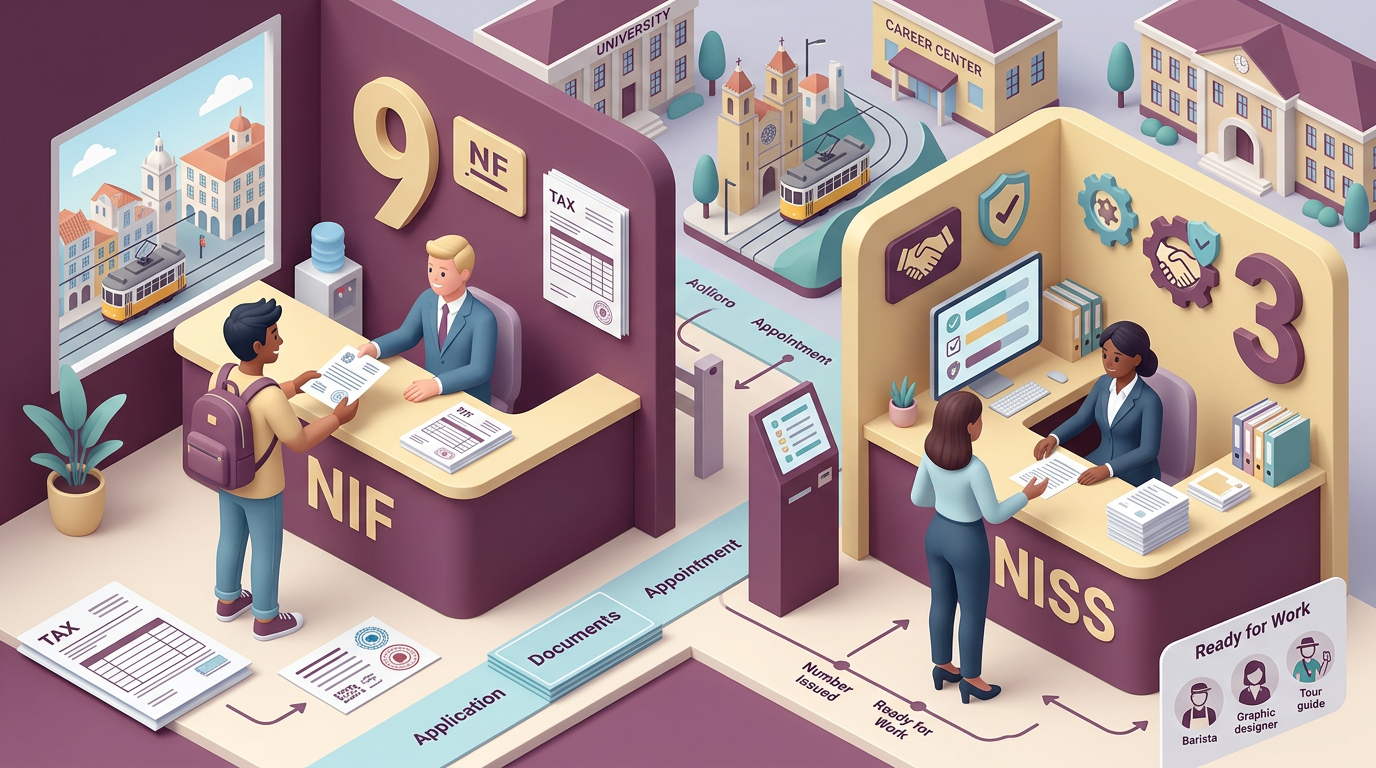
Securing a part-time job as an international student in Portugal is a strategic way to offset living costs while gaining local professional exposure. However, the bureaucracy in 2026 remains rigorous. Before you can sign a contract for a marketing internship or a retail position, you must navigate two critical identifiers: the Número de Identificação Fiscal (NIF) and the Número de Identificação de Segurança Social (NISS). These aren't just digits on a screen; they are your entry keys into the Portuguese fiscal and social welfare systems. Without them, your employment is legally invalid, and you risk complications with AIMA (Agência para a Integração, Migrações e Asilo).
The Portuguese NIF: Your First Fiscal Step
The NIF is the taxpayer identification number issued by the Autoridade Tributária e Aduaneira (AT). As of 2026, every resident or visitor performing a financial transaction—from renting an apartment in Arroios to opening a bank account—needs one. For international students from non-EU/EEA countries, the process traditionally required a fiscal representative (representante fiscal), though digital platforms have streamlined this. In 2026, the standard fee for a NIF certificate remains €0 (Source: Portal das Finanças), but third-party lawyers or digital services typically charge a fee to act as your representative if you are applying from outside the EU.
To obtain your NIF, you must provide a valid passport and proof of address. If you are already in Portugal on a student visa, you can visit a Loja do Cidadão or a Finanças office. We at Facultét often see students confused about whether they need to update their address once they receive their residence permit. The answer is yes. Once your AIMA appointment is finalized and you have your plastic residence card (for those in higher education or secondary education), you must update your fiscal address at the Portal das Finanças to ensure you are taxed as a resident rather than a non-resident, which significantly impacts your take-home pay.
Understanding the NISS for Students
While the NIF deals with taxes, the NISS (Social Security Identification Number) handles your contributions to the welfare state. This number is mandatory if you intend to work part-time. Under the current 2026 regulations, the minimum wage in Portugal is €920 per month (paid over 14 installments, as per the Portuguese Labor Code, Source: Pordata). If you are working the maximum allowed 20 hours per week during the semester, your NISS ensures that your employer correctly deducts your social security contribution while paying their share.
Since the restructuring of migration services and the dissolution of SEF, the NISS Na Hora service has become a primary route for students. You can apply for a NISS at a Segurança Social office by presenting your passport and a work contract or a promise of employment. If you are an entrepreneur or freelancer—perhaps applying skills from a Digital Marketing program—you will need to open an activity (abertura de atividade) on the Tax Portal first, which then triggers the NISS registration process.
Legal Limits: Working on a Student Visa in 2026
The legal framework for international students changed significantly following the September 2026 reforms. Today, your right to work is tied directly to your residence permit status. As an international student in higher education or secondary school with a valid residence card, you are generally permitted to work up to 20 hours per week during term time and full-time during holidays. It is a common misconception that students on vocational training courses (Article 54(1)(k) E9 visa) can work; they cannot. While the law allows work for residence permit holders, the employer must verify that you possess a valid NIF, NISS, and a residence permit (Título de Residência) that allows for professional activity (Article 91, Source: AIMA).
For those looking to transition from study to a high-value career, the technical skills acquired during your degree are paramount. Many students find that bridging the gap between academia and the Portuguese job market requires specialized certification. For instance, moving into tech-heavy roles often necessitates a background in Data Science - Machine Learning & AI to meet the demands of Lisbon's growing hub of international startups. Under the IFICI regime (the "NHR 2.0" successor effective 2024-2026), qualified professionals in these sectors can benefit from specific tax advantages, provided their roles are classified as 'high added value' by the Portuguese government.
Taxation and Your Take-Home Pay
In 2026, the IRS (Imposto sobre o Rendimento de Pessoas Singulares) brackets are adjusted annually (Source: Portal das Finanças). For a student working part-time and earning near the minimum wage threshold, your income tax liability might be zero or very low due to the 'mínimo de existência' (existence minimum), which protects low earners from heavy taxation. However, the 11% Social Security deduction is mandatory from the first Euro earned (Source: Segurança Social). Use the Portal das Finanças to check your 'Recibos Verdes' if you are freelancing, or ensure your 'Folha de Vencimento' (payslip) correctly lists your NIF and NISS to avoid issues during your permit renewal with AIMA.
- Documents for NIF: Passport, proof of address (home country or Portugal), and fiscal representative details for non-residents.
- Documents for NISS: Passport, NIF, and a valid work contract or 'promessa de trabalho'.
- Reporting: Always ensure your employer registers your start date with Segurança Social Directa within 24 hours of your first day (Source: Segurança Social).
Strategic Career Planning
Securing your NIF and NISS is merely the administrative foundation. To succeed in the competitive Portuguese market, especially in cities like Porto or Lisbon, you must align your administrative status with marketable skills. Many international students are currently pivoting toward roles that combine management and technology. Engaging in a Project Management course can provide the structural knowledge needed to lead teams in the local tech ecosystem. Note that for vocational training, students must obtain an E9 temporary stay visa abroad under Article 54(1)(k), which allows for stays up to one year but does not grant the right to work or lead to a residence permit.
Remember that the transition from a higher education student visa (D4) to a work-based residence permit (Article 88.1 or 89.1) requires a valid employment contract. You cannot simply 'switch' from tourism to work or training inside Portugal as the 'Manifestation of Interest' is abolished. Only secondary education students can regularize from inside Portugal without a visa. Therefore, getting your NIF and NISS early allows you to prepare for internships that serve as the gateway to full-time residency after your degree studies.
Frequently asked questions
Can I get a NIF before I arrive in Portugal?
Yes. You can appoint a fiscal representative (a lawyer or a specialized service) to apply for your NIF at the Finanças while you are still in your home country. This is highly recommended as it allows you to sign a lease and set up utilities immediately upon arrival.
Is the NISS mandatory if I am only doing an unpaid internship?
Generally, no. If the internship is strictly educational and unpaid (curricula), you are covered by school insurance. However, if there is any form of compensation or 'subsídio de alimentação' that exceeds legal limits, a NISS may be required for insurance and social contributions (Source: Segurança Social).
How much is the minimum wage in Portugal in 2026?
The national minimum wage for 2026 is €920 per month (Source: Pordata / Government Decree). This is calculated based on 14 payments per year. For part-time students, this is prorated based on the number of hours worked.
Did the abolition of the 'Manifestation of Interest' affect students?
Yes. You can no longer enter as a tourist and apply for legal status through work or study. However, as a registered student with a valid D4 visa (higher education) or D3 visa, you have a legal path to work. Vocational students on E9 visas do not have a work authorization or a path to residence.
Can I work as a freelancer with a student visa?
Yes, higher education students can work as an 'Independent Worker' (Trabalhador Independente). You will need to 'open activity' at the Finanças using your NIF and ensure you are making the appropriate NISS contributions through the social security portal.
Navigating the fiscal landscape in Portugal requires more than just paperwork; it requires a vision for your future career. Whether you are aiming to master data or manage global projects, your administrative readiness is the first step. If you need help choosing the right academic path to secure your future in Portugal, explore our Project Management programs or contact us at Facultét today to align your education with your residency goals.
Data verified as of 2026-09-01.