Short-Term Upskilling for E9 Visa Holders: Maximizing Professional Value During a Temporary Stay in Portugal

Securing an E9 temporary stay visa involves a specific set of legal and logistical parameters that differ significantly from long-term residency tracks. Following the legislative overhaul promulgated on August 31, 2026, which amended Lei 23/2007, the landscape for foreign nationals entering Portugal for vocational training has tightened. The former 'entry points' to residency via professional courses (previously under Art. 92, item 4) are gone. Today, the E9 visa—governed by Art. 54, item 1, alínea k)—serves as a bridge for those seeking high-intensity upskilling without the intent of permanent migration. At Facultét, we see this not as a limitation, but as a focused window to acquire European-standard competencies in a high-growth market.
The Legal Reality of the E9 Visa in 2026
The E9 visa is designed for stays of less than one year. According to AIMA (Agência para a Integração, Migrações e Asilo), this visa allows for multiple entries and is generally processed within 30 days at the consulate of your origin country. However, a critical distinction must be made: the E9 does not lead to a residence permit (autorização de residência). It is a temporary stay vehicle that can be extended once in Portugal under Art. 72, item 1, e), up to a total of 12 months. It does not count towards the five-year residency requirement for Portuguese citizenship, nor does it grant the right to engage in professional activity (work) within the local market.
For those holding this visa, the objective is professional enrichment. Since the 2026 reforms, the path to residency through vocational courses has been effectively closed for anyone not enrolled in ensino secundário or specific level 4 ISCED programs with a pre-arranged Art. 62 resident visa. If you are here on an E9, your focus is the return on investment through knowledge. You can find more details on what changed in the Foreigners Law in 2026 to ensure your expectations align with current AIMA regulations.
Strategic Upskilling: Why DGERT Certification Matters
While the E9 visa holders cannot work, they can study at DGERT-certified institutions. DGERT (Direção-Geral do Emprego e das Relações de Trabalho) is the regulatory body that ensures training quality in Portugal. Earning a certificate from a DGERT-accredited entity like Facultét provides a credential recognized across the European Union, which is invaluable when returning to your home country or applying for remote roles globally.
In the current 2026 economic climate, where the Portuguese minimum wage has reached €920 per month (paid in 14 installments, per Pordata), the cost of living in hubs like Lisbon or Porto remains significant. Rent for a T1 in Arroios or Campanhã rarely falls below €900. Therefore, maximizing the utility of your stay through high-impact courses is the only way to justify the expenditure. We recommend focusing on sectors with the highest global demand: Data Science and Project Management.
High-Impact Learning Paths
- Data Intelligence: For those with a background in business, the Data Science: Machine Learning, Artificial Intelligence & Marketing Analytics course offers a deep dive into predictive modeling, allowing you to return to the global job market as a specialized analyst.
- Strategic Coordination: Managing international teams requires more than just soft skills. The Project Management program at Facultét focuses on Agile and Scrum methodologies, essential for the tech-heavy 2026 corporate environment.
Navigating Logistics: NIF, NISS, and Cost of Living
Even as a temporary E9 holder, you will interact with Portuguese bureaucracy. You must obtain a NIF (Número de Identificação Fiscal) via the Portal das Finanças. While a NISS (Social Security number) is not required for students as they are not working, having a NIF is mandatory for signing a rental contract or setting up utilities. As of September 2026, the 'means of subsistence' requirement checked by AIMA stands at a minimum of €920 for the first month, plus 50% (€460) for each subsequent month, though we advise having at least €12,000 in a bank account to cover a full year of stay without financial distress.
Maximizing Your Stay in Lisbon and Porto
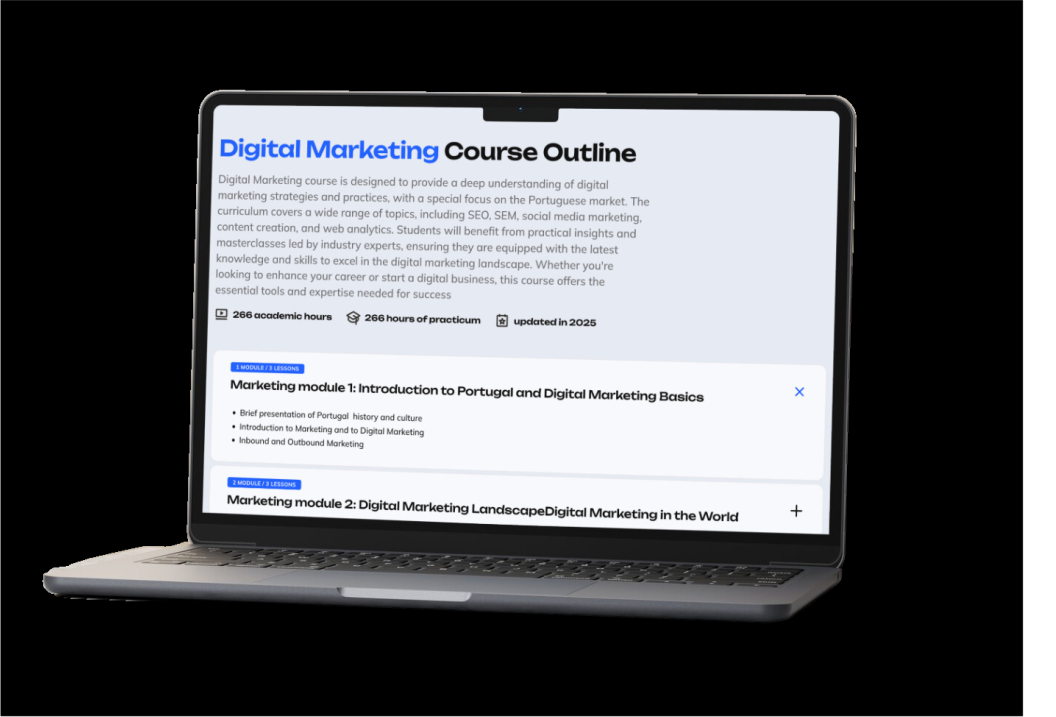
Portugal in 2026 is a tech hub, even if the E9 visa restricts you from local employment. Networking at events like the Web Summit in Lisbon or tech meetups in Porto's Matosinhos district is perfectly legal. Use your time at Facultét to build a portfolio. If you are leaning towards the intersection of tech and sales, our Digital Marketing course provides the tactical skills to manage large-scale campaigns, which is a highly portable skill set for digital nomads once they leave the E9 status behind.
Practical Tips for E9 Students
- Ensure your health insurance (Seguro de Saúde) covers the entire duration of your stay, as required by Art. 54.
- Register your address at the local Junta de Freguesia to get a Certificado de Residência, which helps with local administrative tasks.
- Focus on DGERT-certified hours; these are often transferable to ECTS credits in certain European master's programs later.
Frequently asked questions
Does the E9 visa allow me to work in Portugal?
No. According to current AIMA and IEFP regulations in 2026, the E9 visa is for temporary stay purposes only (study, training, or medical treatment) and does not permit the holder to engage in paid professional activity. If your goal is to work, you must apply for a Work Visa or a Job Search Visa from your country of origin.
Can I convert my E9 visa into a Residence Permit?
As of the September 2026 legal changes, the E9 visa does not convert into a residence permit. The 'Manifestation of Interest' (Art. 88.2) was abolished in 2024. To obtain residency, you must meet the specific criteria of the Resident Visa (Art. 62) and be enrolled in a qualifying ISCED level 4 or secondary education program to be eligible for a Residence Permit (Art. 92, item 1).
What is the minimum bank balance required for an E9 visa?
AIMA requires proof of means of subsistence equivalent to the current minimum wage (€920 as of September 2026). For a 12-month stay, you should demonstrate access to at least €920 for the first month and €460 for each of the following 11 months (calculated as 50% of the RMMG per Portaria n.º 1563/2007), though having the full €920 per month is highly recommended for approval.
How long does it take to get an E9 visa?
Consular processing times vary, but per the current AIMA and Ministry of Foreign Affairs guidelines, a decision is typically rendered within 30 days of the application, provided all documents (DGERT enrollment, housing proof, and NIF) are in order.
Is a DGERT certificate useful outside of Portugal?
Yes. DGERT certification signifies that the training entity meets rigorous quality standards set by the Portuguese Ministry of Labor. These certificates are highly regarded across Europe and serve as credible proof of upskilling for employers worldwide.
The window of time provided by the E9 visa is a strategic asset if used correctly. By choosing a high-level professional course, you ensure that your temporary stay in Portugal yields a permanent boost to your global career trajectory. Whether you are aiming to master Machine Learning & AI or refine your management skills, we in Facultét are here to provide the DGERT-certified excellence you need. Ready to transform your stay? Contact our admissions team today to secure your spot for the next intake.
Data verified as of 2026-09-27.