Remote Work and Study in Portugal: Legal Compliance and DGERT Certification Benefits

Living in Portugal as a hybrid professional in August 2026 requires more than just a laptop and a love for pastel de nata. The landscape for expatriates has shifted significantly since the major legislative reforms of late 2024 and September 2026. Today, those seeking a digital nomad student visa in Portugal must navigate a specific legal framework that balances the requirements of the Digital Nomad Visa (D8) with the academic obligations of a student. Whether you are settling in the tech hubs of Lisbon's Parque das Nações or the historic streets of Porto, understanding the interplay between DGERT-certified training and AIMA regulations is essential for legal compliance.
The 2026 Legal Landscape: D8 vs. E9 Visas
As of late 2026, the distinction between residency paths is sharper than ever. Following the legislative changes of September 2026, vocational and professional training courses (DGERT/QNQ 4 and 5) no longer lead to a residence permit under Article 92. For remote workers who also wish to study vocational courses, two primary paths exist. The D8 Digital Nomad Visa remains the flagship for those earning at least four times the current national minimum wage, offering a path to residency. With the 2026 minimum wage set at €935 per month (as estimated based on recent government growth trends and IEFP reports), a remote worker must demonstrate a recurring monthly income of at least €3,740 to qualify for the D8.
Alternatively, for vocational students, the E9 Temporary Stay Visa under Article 54(1)(k) is the specific path. This visa is for stays under one year, does not convert into a residence permit, and carries no right to work. Transitioning to a residency status is generally restricted unless you already hold a valid residency card from a different path. We in Facultét emphasize that maintaining your legal status depends heavily on applying for the correct visa category abroad.
Why DGERT Certification Matters for Your Legal Stay
For international students and digital nomads, the term DGERT (Direção-Geral do Emprego e das Relações de Trabalho) is a benchmark of quality and legal security. Choosing a DGERT-certified entity for your professional training, such as our Project Management program, ensures that your enrollment is recognized for the issuance of a Temporary Stay Visa (E9). In 2026, AIMA and consular officers strictly verify the legitimacy of training providers against the requirements of Article 23-B of Decreto Regulamentar 4/2022.
DGERT certification isn't just a badge; it is a regulatory requirement that guarantees the educational provider follows strict pedagogical and structural standards. For a digital nomad looking to pivot into tech, enrolling in Data Science - Machine Learning & AI through a certified body provides the necessary documentation to justify your stay in Portugal. Furthermore, DGERT-certified courses are often VAT-exempt under Article 9 of the Portuguese VAT Code (CIVA), which can represent a significant saving on tuition fees.
Income Requirements and Social Security in 2026
Financial solvency remains the pillar of the digital nomad student visa in Portugal. According to the latest 2026 guidelines from Social Security (Segurança Social), remote workers operating as freelancers (trabalhadores independentes) must register their activity via the Portal das Finanças. Once registered, you are liable for social security contributions, which generally hover around 21.4% of your relevant income (calculated on 70% of service income), though exemptions may apply for the first 12 months of activity for new registrants.
To secure a residency card (via the D8 path) or a stay visa, you must provide:
- A contract of work or proof of independent income exceeding €3,740/month for the D8 path (4x current minimum wage as per AIMA/IEFP).
- Proof of enrollment in a DGERT-certified course for the E9 Temporary Stay Visa.
- A valid NIF (Número de Identificação Fiscal) with a Portuguese bank statement showing sufficient means of subsistence.
- A lease agreement registered with the Autoridade Tributária (AT).
Taxation: Beyond the NHR Era
The original Non-Habitual Resident (NHR) regime is no longer available for new applicants in 2026. It has been replaced by the IFICI (Incentivo Fiscal à Investigação Científica e Inovação), often colloquially called NHR 2.0. This new regime is highly targeted. Digital nomads who are also students in high-value-added fields, such as those studying Data Science: Machine Learning, Artificial Intelligence & Marketing Analytics, may qualify if their professional activity falls under the specific categories defined by the government, such as tech innovation or scientific research.
Under IFICI, qualifying individuals enjoy a 20% flat rate on employment or self-employment income for ten years. However, the application must be submitted to the Portal das Finanças. If you do not qualify for IFICI, you will be taxed at the standard progressive rates, which in 2026 range from 13% to 48%, depending on your global income brackets (subject to annual Budget adjustments by the Portal das Finanças).
Practical Challenges: Visa Compliance and Timelines
Patience is a prerequisite for the digital nomad student visa in Portugal. In 2026, vocational students must be aware that the E9 visa is valid for up to one year and does not count toward Portuguese citizenship. During your stay, your visa sticker in your passport serves as your legal document. Under Article 72(1)(e), extensions for E9 visas may be requested in-country, but they do not lead to a residence permit.
We in Facultét recommend that students and workers keep a digital folder of every 'recibo verde' (green receipt) issued and every monthly Social Security payment. If you are on a D8 residency path, this paper trail proves your integration into the Portuguese economy. If you are working remotely for a company outside the EU, ensure your contract specifically mentions your right to work remotely from Portugal, as this is a common request during the D8 interview process.
Frequently asked questions
Can I switch from a tourist visa to a work visa in 2026?
No. The 'manifestation of interest' (Articles 88.2 and 89.2) was abolished in June 2024, and subsequent 2026 reforms further restricted in-country legalisation. You must apply for a D8 Digital Nomad visa or a suitable study visa at a Portuguese consulate in your home country before arriving in Portugal. Regularisation from inside the country for vocational students is not permitted.
What is the minimum income for a Digital Nomad visa in 2026?
Based on the estimated 2026 minimum wage of €935, you must prove a monthly income of at least €3,740 (4x the minimum wage) to qualify for the D8 visa. This must be demonstrated through bank statements and a formal employment or service contract, as required by AIMA.
Does a vocational student visa allow me to work?
No. Under the September 2026 changes to Article 92 and the implementation of the E9 visa for vocational training under Article 54(1)(k), these students are not permitted to engage in professional activity and the visa does not lead to residency.
Why should I choose a DGERT-certified course?
DGERT certification ensures the training is legally recognized by the Portuguese state, which is a mandatory requirement for the E9 Temporary Stay visa. It also ensures tax deductions on education expenses and that the certificates have professional value within the EU.
Is the NHR tax status still available for students?
The old NHR is closed. New residents may apply for the IFICI (NHR 2.0) if they work in specific 'high value' sectors. Most digital nomads in tech, data science, or engineering will need to verify if their specific job role fits the current IFICI list on the Portal das Finanças.
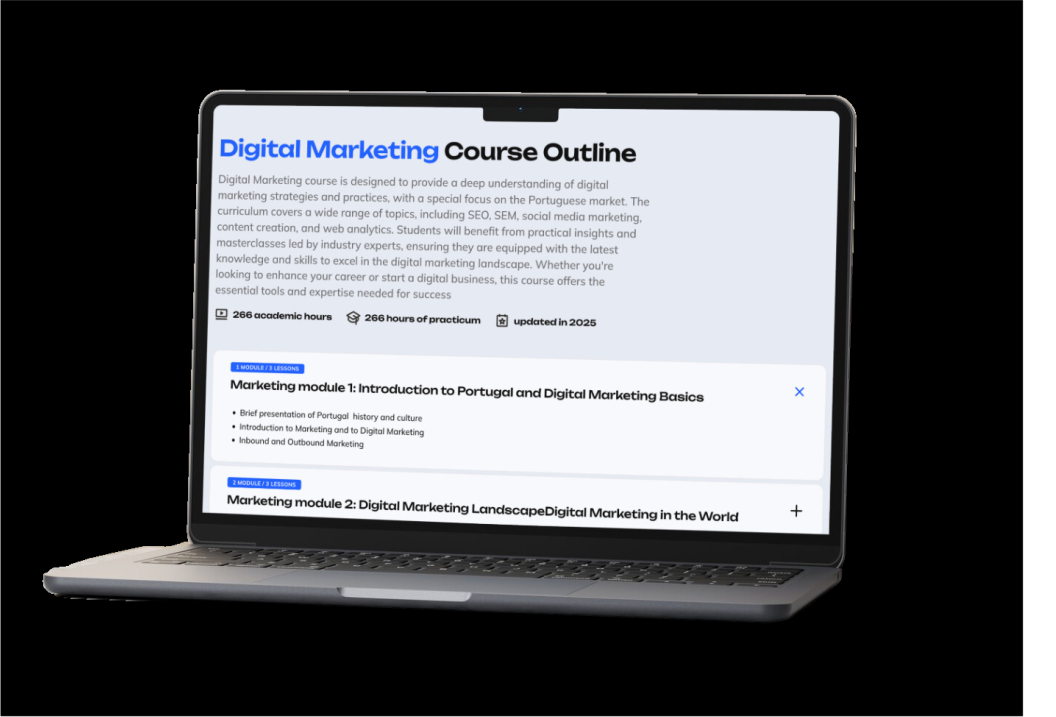
Navigating the intersection of remote work and Portuguese education requires a strategic approach to legal compliance. By selecting an accredited path and maintaining rigorous financial records, you can enjoy the exceptional quality of life Portugal offers. To ensure your education meets the highest national standards, explore our Digital Marketing program or contact our advisors at Facultét today to discuss how our DGERT-certified training aligns with current regulations.
Data verified as of 2026-08-24. Updates reflect Law 2026 amendments.