Professional courses lasting over 12 months in Portugal for foreigners in English

Professional courses lasting over 12 months in Portugal for foreigners in English are increasingly relevant for students, career changers, and relocating professionals who want practical training, a recognized learning pathway, and a realistic route into the Portuguese and wider EU job market. In Portugal, the key questions are not only language and duration, but also whether a provider is DGERT-certified, how the course fits visa rules, what costs to expect in Lisbon, Porto, Coimbra, or Braga, and whether the qualification supports employability, recognition, or further study.
Why Portugal is attractive for long professional courses
Portugal combines comparatively moderate living costs, strong international appeal, and a growing market for digital, tech, business, and project-based roles. For foreigners, it is one of the more accessible EU destinations because:
- English is widely used in higher education, tech, tourism, and international business environments, especially in Lisbon and Porto.
- Portugal offers several residence pathways that may be relevant depending on your profile, including the student visa, D7, D8, and the job seeker visa.
- DGERT-certified training providers add a layer of credibility and quality assurance in vocational education.
- The country has active hiring in digital marketing, data, software, shared services, customer operations, and project support roles.
If your goal is practical skills rather than a traditional degree, a long-form professional course can be a strong alternative—provided you verify certification, delivery language, duration, and administrative fit for your immigration situation.
What “over 12 months” usually means in Portugal
When people search for Courses over 12 months with DGERT certification in Portugal, they are often mixing several educational formats:
- Vocational or professional training courses from private schools or training centers
- Postgraduate or specialized programs at universities or polytechnics
- Modular professional pathways combining several certificates over 12+ months
- Blended or part-time programs designed for working adults and international residents
In Portugal, not every long course automatically leads to an academic degree, and not every certificate has the same legal or professional weight. That is why foreigners should distinguish between:
- DGERT certification of the training provider — quality recognition of the training entity.
- State-regulated academic qualifications — degrees awarded by recognized higher education institutions.
- Professional recognition or equivalency — relevant if you need your previous diploma recognized in Portugal.
DGERT certification: what it means for foreigners
DGERT is the Portuguese Directorate-General for Employment and Labour Relations. A DGERT-certified entity has recognized compliance in training organization and quality procedures. This matters for foreigners because it signals a more structured and credible provider, especially in the professional training market.
Official source: DGERT
However, it is important to be precise: DGERT certification does not mean the same thing as a university degree, nor does it automatically guarantee immigration eligibility by itself. It confirms the training provider’s certified status, not universal academic equivalence.
For career-focused international students, a DGERT-certified school such as Facultét is especially relevant if you want structured, market-oriented learning in English in fields with strong employer demand.
Best cities in Portugal for foreigners taking long professional courses
Lisbon
Lisbon is the strongest market for international jobs, startups, digital roles, and multinational offices. It also has the highest cost of living in Portugal.
- Room in shared apartment: around €500–€900/month
- Studio or 1-bedroom: around €900–€1,600+/month
- Monthly transport pass: around €40
- Best for: tech, marketing, project management, scale-ups, English-speaking workplaces
Porto
Porto has a strong tech and services ecosystem and is often slightly more affordable than Lisbon, though rents have risen sharply in recent years.
- Room in shared apartment: around €400–€750/month
- Studio or 1-bedroom: around €800–€1,300/month
- Best for: tech, digital business, international services, growing startup scene
Coimbra
Coimbra remains one of Portugal’s classic education cities. It is generally more affordable and student-oriented, though with a smaller international job market than Lisbon or Porto.
- Room in shared apartment: around €250–€500/month
- Studio or 1-bedroom: around €500–€850/month
- Best for: lower living costs, quieter study environment, academic tradition
Braga
Braga has grown in popularity due to quality of life, relative affordability, and increasing business activity in the north.
- Room in shared apartment: around €300–€550/month
- Studio or 1-bedroom: around €550–€900/month
- Best for: affordability, lifestyle balance, access to northern Portugal job markets
Typical tuition and total budget in EUR
For foreigners evaluating professional courses lasting over 12 months in Portugal for foreigners in English, total cost usually includes tuition, housing, transport, food, health insurance, and residence-related expenses.
| Cost item | Estimated range |
|---|---|
| Professional course tuition | €2,500–€9,000+ per year, depending on provider and specialization |
| Shared accommodation | €250–€900/month depending on city |
| Food and groceries | €200–€350/month |
| Transport | €30–€50/month |
| Utilities and internet | €80–€150/month if not included |
| Private health insurance | €20–€60+/month, depending on policy |
A realistic monthly living budget is often:
- Coimbra/Braga: €700–€1,100
- Porto: €900–€1,400
- Lisbon: €1,100–€1,800+
These are practical planning figures, not legal thresholds. Always confirm current financial proof requirements with Portuguese consular authorities.
Which visas may be relevant
Your visa route depends on your purpose, nationality, and source of income. For up-to-date rules, check the official portals of the Portuguese government and consular authorities.
Student visa
This is the most obvious route if your primary purpose is study. Eligibility depends on the type of institution, course structure, admission documents, proof of funds, accommodation, and insurance. Not every private training format is treated identically, so foreigners must confirm whether a specific program supports a student residence process.
D7 visa
The D7 is generally used by people with stable passive or recurring income, such as pensions, rentals, or dividends. Some foreigners study while residing under D7, but the visa itself is not a study visa.
D8 digital nomad visa
The D8 is aimed at remote workers with qualifying income. This can be relevant if you want to live in Portugal while taking a part-time or online professional course in English.
Job seeker visa
This visa is designed for those entering Portugal to look for work. It may be relevant after or alongside upskilling, but it is not a substitute for a student pathway when your main purpose is long-term study.
Recognition of prior diplomas and equivalency in Portugal
If you already hold a foreign diploma and want it recognized in Portugal, you may need recognition/equivalency depending on your goals. This is especially important if you plan to continue into regulated professions or formal higher education pathways.
Recognition is handled through the Portuguese higher education system. Official information is available here:
In practical terms:
- A professional course does not usually require prior degree recognition unless the provider or pathway specifically asks for it.
- If you want to use an existing foreign degree for further academic study or regulated employment, recognition may be necessary.
- Professional training certificates and academic equivalency are different processes.
What fields make the most sense for foreigners
Long professional training is most valuable when it leads to skills that employers in Portugal actively need and that can be demonstrated in English-speaking or international environments.
Digital marketing
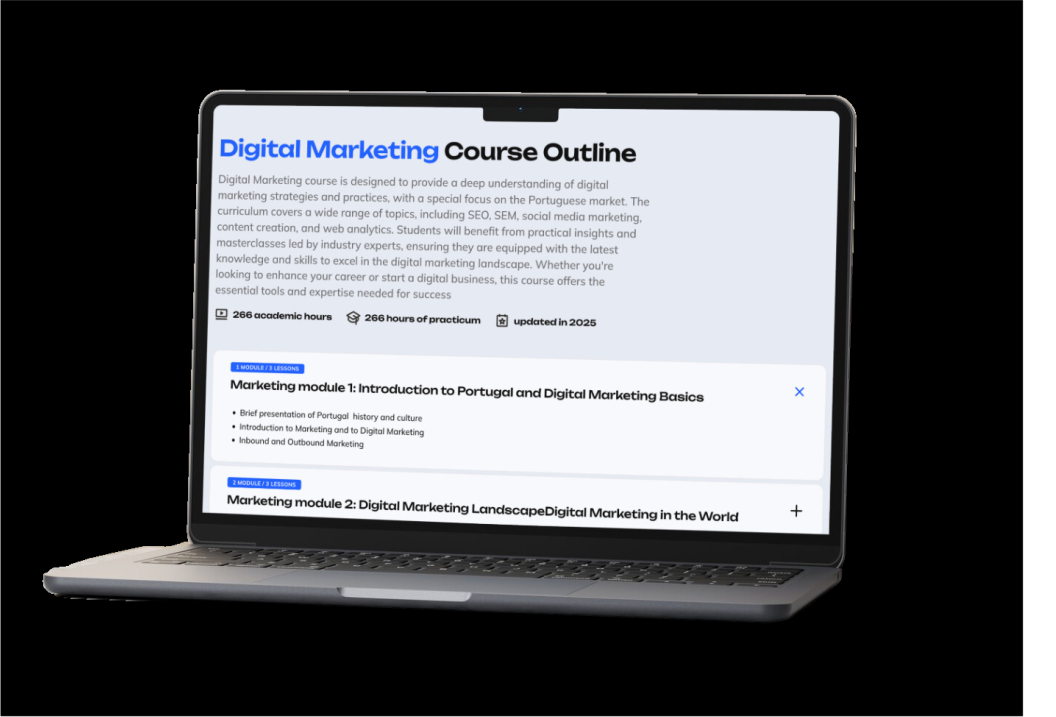
Portugal has strong demand in performance marketing, content, CRM, analytics, SEO, e-commerce, and growth roles. For a practical route, consider Digital Marketing.
Data, AI, and analytics
Data literacy and applied AI have become important across marketing, operations, finance, and product teams. Relevant upskilling paths include Data Science - Machine Learning & AI and Data Science: Machine Learning, Artificial Intelligence & Marketing Analytics.
Project management
Companies in Portugal increasingly need professionals who can coordinate cross-functional work, especially in IT, business services, construction, and digital transformation. A structured option is Project Management.
Portugal’s job market after training
Foreigners should be realistic: Portugal offers opportunity, but salaries are typically lower than in northern Europe or North America. The trade-off is often lifestyle, safety, climate, and access to the EU market.
Areas with stronger hiring potential include:
- Digital marketing and e-commerce
- Data analysis and BI support
- AI-assisted business operations
- Project coordination and PMO roles
- Customer success and shared service centers
- Tourism, hospitality, and multilingual operations
For employment support and labor market data, use official Portuguese sources:
In Lisbon and Porto, international companies often value English plus one additional language. Portuguese is not always mandatory for entry-level international roles, but it significantly improves long-term employability and local integration.
Cultural realities foreigners should know
- Portuguese administration can be slow. Start paperwork early, especially for housing, tax number, bank account, and residence appointments.
- Relationship-building matters. Professional communication is usually polite and less aggressive than in some Anglo markets.
- Housing is competitive. This is especially true in Lisbon and Porto; secure accommodation as early as possible.
- Portuguese language helps. Even if your course is in English, basic Portuguese improves daily life and job options.
- Schedules may differ. Lunch breaks, customer service timing, and local administrative routines can feel slower than expected.
How to choose the right long course in Portugal
- Verify DGERT status if you want a certified vocational training provider.
- Confirm the language of instruction in writing—do not assume full English delivery.
- Check the exact duration and weekly load to see whether it fits your visa or work situation.
- Ask what certificate is issued and how employers typically view it.
- Review career relevance rather than choosing only by low tuition.
- Calculate full living costs for Lisbon, Porto, Coimbra, or Braga before committing.
- Confirm immigration compatibility directly with the provider and official visa authorities.
Is a 12+ month professional course in Portugal worth it?
For many foreigners, yes—if the course is in English, linked to employable skills, delivered by a credible provider, and matched to a viable residence strategy. Portugal is particularly strong for people seeking a practical, internationally relevant education path in digital, business, and applied tech fields.
Facultét’s DGERT-certified training model is well aligned with this demand: professional, skills-based, and designed for real labor market outcomes rather than purely theoretical learning.
If you want to compare an English-language pathway in a high-demand field, explore the Digital Marketing course or contact the school via /contact to discuss your study goals, background, and eligibility.
Часто задаваемые вопросы
Can foreigners study professional courses in English in Portugal for more than 12 months?
Yes, foreigners can study long professional courses in Portugal, including programs delivered in English. The key factors are the provider’s status, the course format, and whether the program fits your residence or visa situation.
Does DGERT certification mean a course is automatically recognized everywhere?
No. DGERT certification confirms the training provider meets Portuguese quality standards for vocational training. It is not the same as an academic degree or automatic international equivalency.
Which city is best for international students taking professional courses in Portugal?
Lisbon is strongest for international jobs and English-speaking opportunities, Porto offers a good balance of market access and cost, while Coimbra and Braga are generally more affordable for students.
How much do long professional courses in Portugal cost for foreigners?
Tuition often ranges from about €2,500 to €9,000+ per year depending on the specialization and provider. Monthly living costs usually range from around €700 in smaller cities to €1,800+ in Lisbon.
Can I work in Portugal after completing a professional course?
Potentially yes, but your right to work depends on your immigration status and the specific legal pathway available to you. Completing a practical course in digital, data, or project management can improve employability.
Do I need to recognize my foreign diploma before joining a professional course in Portugal?
Usually not for vocational training, unless the provider requires it. Recognition is more commonly needed for academic progression or regulated professions.