Portuguese Language Level for Residency and Work: DGERT Certification and Career Paths in 2026
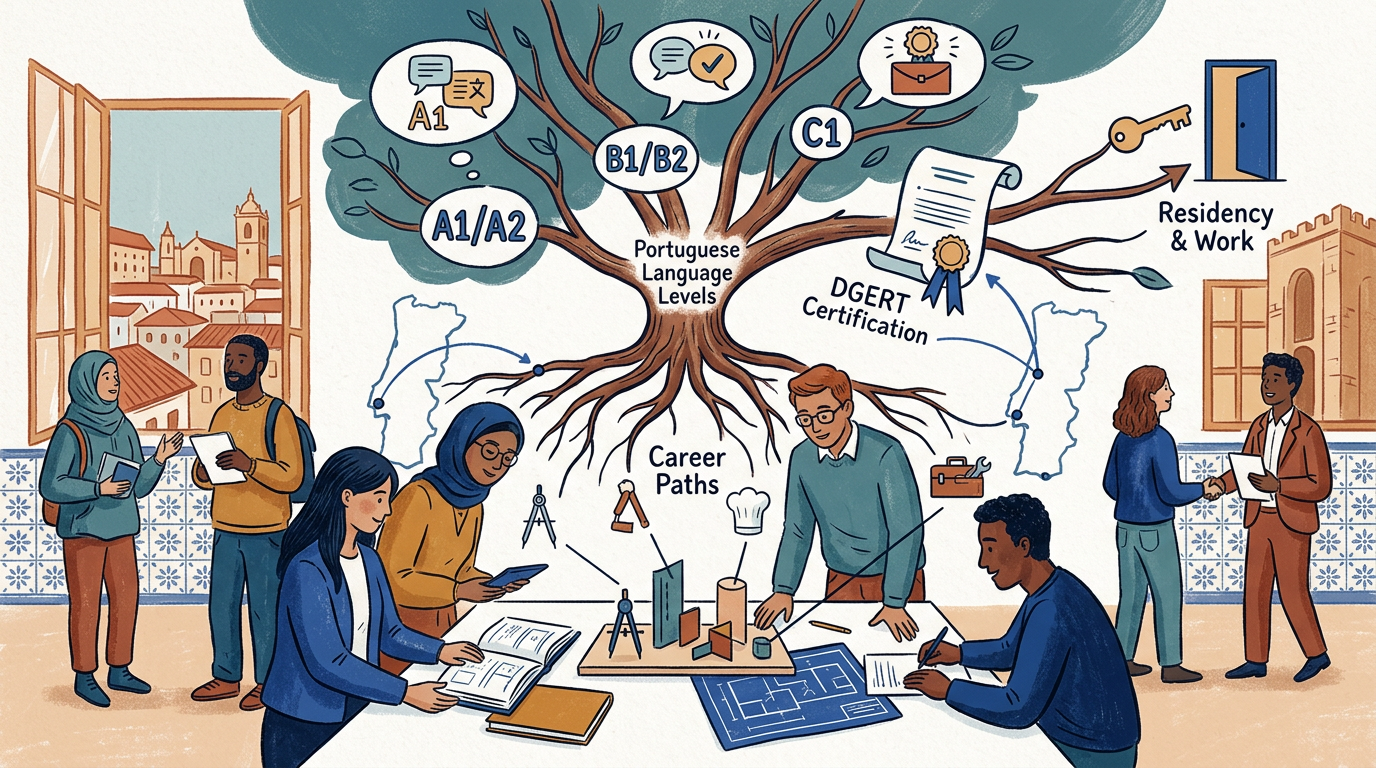
Navigating the Portuguese administrative landscape in 2026 requires more than just a passing knowledge of local customs. As the Agência para a Integração, Migrações e Asilo (AIMA) streamlines processes following the 2024 legislative shifts, understanding the specific Portuguese language level for residency and work has become a non-negotiable step for long-term integration. Whether you are targeting a Residence Permit (Título de Residência) or planning for eventual citizenship after five years of legal residency, the benchmark remains clear: you must demonstrate functional proficiency at the A2 level, according to the Common European Framework of Reference for Languages (CEFR).
The A2 Requirement for Residency and Citizenship
As of 2026, the threshold for obtaining permanent residency or Portuguese nationality is the CIPLE (Certificado Inicial de Português Língua Estrangeira) at the A2 level. While initial temporary residence permits—such as those granted for Digital Nomads (D8) or D7 visa holders—do not mandate a language test, the transition to permanent status or the application for citizenship after the five-year mark triggers the A2 requirement. According to current AIMA guidelines, applicants must prove they can understand basic sentences, communicate in simple tasks, and describe their background in elementary terms.
Proof of proficiency can be provided through primary channels: a certificate from the CAPLE (Centro de Avaliação de Português Língua Estrangeira), a certificate from a public school or IEFP (Instituto do Emprego e Formação Profissional) center, or a certificate from a DGERT-certified training provider providing the PLA (Português Língua de Acolhimento) program. At Facultét, we emphasize that DGERT (Direção-Geral do Emprego e das Relações de Trabalho) certification ensures the training quality meets the rigorous standards required by the Portuguese state, making these certificates highly credible during labor market integration.
Language Expectations in the 2026 Job Market
While the law sets the floor at A2 for legal paperwork, the professional market in Lisbon, Porto, and Braga demands significantly more. In 2026, the Portuguese minimum wage (Salário Mínimo Nacional) has reached €920 per month across 14 payments (Pordata/Portal das Finanças). However, for high-value roles in the tech and management sectors, English is the primary working language, but Portuguese is the social and bureaucratic glue. If you are pursuing a career in Project Management, for instance, B2-level proficiency is often the unofficial requirement to manage local stakeholders and navigate Portuguese labor regulations.
The elimination of the Manifestation of Interest (Manifestação de Interesse) via Lei 9/2024 means that foreign workers must now enter with a valid work visa or search for work via the specific Job Seeker Visa. In this competitive environment, having a DGERT-certified course on your CV serves two purposes: it fulfills the legal training requirements often requested by the IEFP for unemployed residents and signals to employers that you have invested in professional-grade Portuguese communication skills.
DGERT Certification: Why It Matters for Your Career
DGERT is the entity responsible for the quality of vocational training in Portugal. When a course is DGERT-certified, it means the entity follows strict pedagogical structures, trainer qualifications, and administrative transparency. For an expat, choosing a DGERT-certified program is not just about learning verbs; it is about obtaining a document that is recognized by the Portuguese State for tax deductions (via e-fatura under the Education category) and for points in certain public job applications.
In specialized fields like data analytics, the ability to interpret local market data requires more than just technical skill. Professionals enrolled in Data Science for Marketing often find that their technical insights are better received when they can present them using the correct Portuguese business terminology. This blend of technical prowess and linguistic cultural fit is what separates high earners from the baseline.
Strategic Steps for New Arrivals in 2026
If you have arrived in Portugal under the CPLP (Community of Portuguese Language Countries) mobility rules or a standard D1/D2 visa, your integration timeline should prioritize NIF/NISS acquisition followed immediately by language certification. The AIMA portals currently experience high volumes for scheduling the A2 exam (CIPLE), so many residents opt for the "Português Língua de Acolhimento" (PLA) courses, which are frequently oversubscribed. Private DGERT-certified centers offer a faster, more tailored alternative.
- Step 1: Secure your NIF and NISS via the Portal das Finanças and Segurança Social.
- Step 2: Enroll in an A2-level course that provides a certificate valid for the AIMA residency processes.
- Step 3: Supplement language learning with technical upskilling in high-demand fields like Digital Marketing to increase your salary potential beyond the €920 minimum.
- Step 4: Apply for the permanent residence permit or citizenship once the 5-year residency clock (calculated from the date of the first permit application) is complete.
The Impact of the 2024 Reforms on 2026 Residency
The year 2026 marks the first wave of residents who must navigate the full impact of the Lei 9/2024. With the "tourism-to-work" pathway closed, the focus has shifted to pre-arrival compliance and post-arrival integration. AIMA now prioritizes applicants who show clear integration markers. A DGERT-certified language certificate is arguably the strongest marker of integration you can present. It shows that you are not just a temporary resident, but a contributing member of the Portuguese economy.
Furthermore, for those operating under the IFICI tax regime (the successor to the NHR), maintaining high-value professional activity is key to tax optimization. This professional activity often requires a level of Portuguese that allows for contract negotiation and understanding of the Código do Trabalho (Labor Code). Even if your daily work in a tech hub like Hub Criativo do Beato is in English, your legal and fiscal life is conducted entirely in Portuguese.
Frequently asked questions
What is the minimum Portuguese language level for residency in 2026?
For temporary residence permits, there is usually no language requirement. However, to obtain Permanent Residency or Portuguese Citizenship after 5 years, you must prove A2 level proficiency (Elementary) through a CIPLE exam or a certified PLA course certificate.
Can I still apply for residency if I entered as a tourist?
No. Following the revocation of Articles 88.2 and 89.2 in June 2024 (Lei 9/2024), the Manifestation of Interest is no longer available. You must apply for a proper visa (Work, Job Seeker, D7, D8, etc.) at a Portuguese consulate before arriving, or transition from a valid Residence Permit (e.g., Student under Article 88.1/89.1) if you have a job contract and meet the legal criteria.
What is the Portuguese minimum wage in 2026?
As of 2026, the national minimum wage is €920 per month, paid 14 times a year, totaling €12,880 annually. This figure is monitored by the Ministry of Labour and reported by Pordata.
Does a DGERT certificate help with the AIMA residency process?
Yes. A certificate from a DGERT-certified training entity is recognized by Portuguese authorities as proof of vocational training and, when part of the PLA framework, serves as proof of language proficiency for permanent residency and citizenship.
Is the NHR tax regime still available?
The original NHR regime is closed to new applicants. It has been replaced by the IFICI (Incentivo Fiscal à Investigação Científica e Inovação), often called "NHR 2.0", which targets specific highly qualified professions and scientific research. Consult the Portal das Finanças for updated eligibility in 2026.
Achieving the right Portuguese language level for residency and work is the single most effective way to secure your future in Portugal. Whether you are aiming for citizenship or a high-paying role in the local economy, we in Facultét are ready to support your journey with certified training. Explore our Project Management program or contact us today to align your skills with Portuguese professional standards.
Data verified as of 2026-08-28.