Mastering the Portuguese Job Interview: How DGERT Certification Bridges Cultural Gaps

Landing a job in Lisbon’s tech hubs or Porto’s creative districts requires more than just a polished CV. By August 2026, the Portuguese labor market has shifted towards high-specialization demands and strict regulatory compliance. Following the full implementation of Lei 9/2024, the path to residency is now strictly tied to pre-arranged employment or specific highly qualified activity visas. For foreigners, the interview is no longer just a personality test; it is a demonstration of legal readiness and professional alignment with European standards. Success hinges on understanding local social etiquette and proving that your skills meet the rigorous DGERT (Direção-Geral do Emprego e das Relações de Trabalho) quality benchmarks.
The Cultural Landscape of Portuguese Interviews
Portuguese business culture sits at a unique crossroads of traditional hierarchy and modern Mediterranean flexibility. While startups in Parque das Nações may adopt a casual tone, the underlying structure remains formal. When preparing your Portuguese job interview tips for foreigners, the first rule is punctuality, despite the stereotypes. Arriving five minutes early signals respect for the recruiter’s time. Initial interactions usually involve a handshake and a formal address—use 'Senhor' or 'Senhora' followed by the surname unless explicitly invited to use first names.
Communication in Portugal is often indirect. Instead of the aggressive self-promotion common in US markets, Portuguese recruiters value humility paired with concrete evidence of expertise. We at Facultét often observe that candidates who mention their ongoing professional development—specifically through DGERT-certified entities—gain immediate trust. This certification acts as a localized quality seal, assuring the employer that your training adheres to the national vocational framework.
Salary Negotiations and the 2026 Economic Context
Discussing money can be delicate. As of August 26, 2026, the national minimum wage in Portugal stands at €920 per month according to government updates, paid over 14 installments per year (a statutory requirement according to the Código do Trabalho, Article 264). When a recruiter asks about salary expectations, they are usually thinking in terms of gross annual income (bruto anual). You must account for the 11% Social Security (Segurança Social) deduction and the progressive IRS (personal income tax) brackets defined in the 2026 State Budget.
Highly qualified professionals in fields like Project Management are currently seeing average starting offers between €35,000 and €45,000 gross per year in Lisbon as per Pordata market indicators. For those applying under the IFICI regime (the successor to the NHR), it is vital to mention your eligibility during the later stages of the interview, as this tax efficiency benefits both the employee's net take-home pay and the employer's long-term retention strategy.
The DGERT Advantage: Bridging the Credibility Gap
For a foreigner, the biggest hurdle is "translatability." Will your foreign degree or past experience work in a Portuguese context? This is where DGERT certification becomes your strongest leverage. DGERT is the regulatory body that certifies training providers in Portugal. By choosing a program like Data Science - Machine Learning & AI that carries these credentials, you signal to the recruiter that you have been vetted by Portuguese educational standards.
During the interview, explicitly mention your DGERT-certified training. It shows that you are not just a transient worker but a professional who has invested in local integration. In 2026, with the AIMA (Agência para a Integração, Migrações e Asilo) focusing heavily on the professional merits of visa applicants, having a certificate recognized by the Ministry of Labour provides a safety net for companies worried about the bureaucratic hurdles of hiring non-EU citizens.
Technical Preparation and Soft Skills
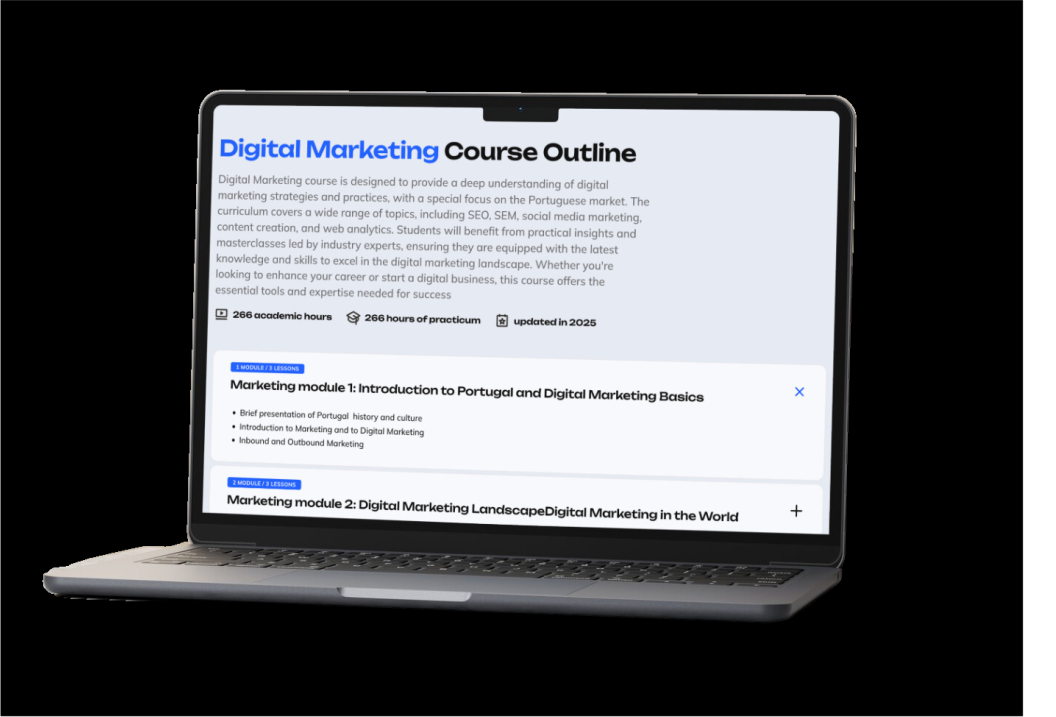
Portuguese companies are increasingly focused on digital transformation. If you are interviewing for a role in marketing, demonstrating knowledge of localized data trends is essential. Mentioning specific tools and methodologies learned in a Digital Marketing course can set you apart. Beyond technicalities, recruiters look for 'relacionamento interpessoal'—the ability to work within a team without causing friction. Show interest in the company’s history and its role in the Portuguese economy. Research their recent projects on the Portal das Finanças or news regarding their European expansion.
The Legal Checklist for 2026
- Verify your NIF (Número de Identificação Fiscal) and NISS (Número de Identificação da Segurança Social) status; recruiters will ask if you have these ready.
- Ensure you understand the terms of your specific visa (D1, D3, or the CPLP mobility framework managed by AIMA).
- Be prepared to explain how your status allows for an immediate contract (Contrato de Trabalho), as the old 'Manifestation of Interest' is no longer a valid route for new arrivals following Decreto-Lei 37-A/2024.
Frequently asked questions
What is the current minimum wage in Portugal for 2026?
As of August 2026, the national minimum wage is €920 per month (Source: Segurança Social). This is paid in 14 installments (including Christmas and holiday bonuses), totaling €12,880 annually. This figure is updated by the Portuguese government based on the 2026 minimum wage targets.
Is the Manifestação de Interesse still a valid way to get a job?
No. Under the legislative changes that culminated in mid-2024 (Lei 9/2024), the Manifestation of Interest (Articles 88.2 and 89.2) was abolished. To work in Portugal in 2026, you must arrive with a valid work visa or a job search visa, according to the current AIMA regulations.
Why do employers ask for DGERT-certified training?
DGERT certification ensures that the training provider meets strict pedagogical and organizational standards set by the Portuguese Ministry of Labour (DGERT/MSESS). It reduces the risk for employers by guaranteeing the quality and local relevance of the candidate's skills.
Can I still apply for the NHR tax status?
The original NHR (Non-Habitual Resident) regime is closed to new applicants since 2024. It has been replaced by the IFICI (Incentivo Fiscal à Investigação Científica e Inovação), which offers tax benefits to specific highly qualified roles listed by the government. You should verify your eligibility based on your specific job code via the Portal das Finanças (Autoridade Tributária).
Do I need to speak Portuguese for all jobs in Lisbon?
While tech hubs use English as a primary language, speaking Portuguese is a significant competitive advantage. Even a B1 level demonstrates commitment to the culture, which is highly valued during the 'interpessoal' evaluation phase of the interview.
Navigating the Portuguese job market in 2026 requires a blend of localized knowledge and certified expertise. Don't leave your career to chance. If you are ready to align your skills with Portuguese regulatory standards and stand out to top recruiters, explore our Data Science: Machine Learning, Artificial Intelligence & Marketing Analytics program or reach out to our team at /contact to find the right DGERT-certified path for your goals.
Data verified as of 2026-08-26.