Leaving Czechia for Portugal: Student Visa Transfer Explained
Relocating from Prague or Brno to the sun-drenched campuses of Lisbon and Porto has become a strategic move for many internationals in 2026. While the Czech Republic offers a solid technical foundation, Portugal’s burgeoning tech scene and the rise of DGERT-certified professional training programs provide a distinct path toward career acceleration in Southern Europe. However, migrating your legal status is not a simple 'transfer' of a residency permit; it involves navigating the transition between two distinct Schengen jurisdictions under the latest AIMA (Agência para a Integração, Migrações e Asilo) regulations.
Legal Reality: Can You Convert a Czech Visa in Portugal?
As of September 2026, there is no automatic conversion mechanism that turns a Czech student long-term visa (visa type D) into a Portuguese residence permit while standing on Portuguese soil. Following the repeal of the 'Manifestation of Interest' pathway and changes to Article 92, students must follow strict legal channels. If you are currently studying in Czechia and wish to move to Portugal for a professional course, you must apply for an E9 Temporary Stay Visa under Article 54(1)(k) through the Portuguese consulate in Prague. You cannot simply arrive in Lisbon as a tourist and hope to 'switch' your status; doing so often leads to immediate rejection of future applications.
According to AIMA guidelines, if your Czech residence permit is valid for more than 90 days, you are eligible to submit your application via the VFS Global center in Prague. We at Facultét often see students underestimate the processing times; currently, the consulate requires between 30 to 90 days to issue a decision. For vocational training, the E9 visa allows you to stay for up to one year with multiple entries but does not lead to a residence permit or count toward citizenship time.
DGERT Certification: The Key to Your Portuguese Visa
In 2026, the Portuguese Ministry of Science, Technology and Higher Education and the Ministry of Labor are extremely specific about which institutions qualify for a visa. To obtain an E9 visa for training, you must be enrolled in a program recognized by DGERT (Direção-Geral do Emprego e das Relações de Trabalho). Note that under the new law, vocational courses no longer qualify for a full residence permit under Article 92; they are restricted to temporary stays.
For those looking to pivot into high-demand sectors, choosing a comprehensive Project Management program or a technical track like Data Science - Machine Learning & AI ensures that your enrollment satisfies the rigorous DGERT audit requirements. These programs typically require a minimum of 15 to 20 hours of study per week, a detail that consular officers check during the visa review.
Financial Requirements and Subsistence in 2026
Portugal has updated its minimum wage (Salário Mínimo Nacional) to €920 per month for 2026, as confirmed by official government decrees and Pordata statistics. This figure is the baseline for your financial proof. To secure a student or training visa, you must demonstrate the ability to support yourself for the duration of your stay.
- Minimum Balance: You should show at least €11,040 (€920 x 12 months) in a bank account. While a Czech bank statement is sometimes accepted, AIMA and consulates strongly prefer a Portuguese bank statement linked to your NIF (Número de Identificação Fiscal).
- Accommodation: You must provide a rental agreement (contrato de arrendamento) registered with the Autoridade Tributária (AT) or a term of responsibility. A simple Booking.com reservation is no longer sufficient for the visa application in 2026.
- Health Insurance: A standard travel insurance policy won't cut it. You need a plan with a minimum coverage of €30,000, valid for the entire stay, or a PB4 form if your home country has a bilateral agreement with Portugal.
The Step-by-Step Transition Timeline
Success in moving from the Czech Republic to Portugal depends on timing. Do not let your Czech permit expire before you have secured your Portuguese visa sticker. First, secure your NIF through a fiscal representative or by visiting a Finanças office during a short trip to Portugal. Second, open a bank account—many digital banks now facilitate this, but traditional institutions remain the gold standard for immigration officials.
Once you have your DGERT enrollment confirmed—perhaps in a specialized course like Data Science: Machine Learning, Artificial Intelligence & Marketing Analytics—you book your appointment at the Prague VFS center. Upon receiving your E9 visa, you travel to Portugal. For vocational students, the E9 is valid for the duration of the course (up to one year) and does not require an AIMA appointment for a residence card, as it is a temporary stay visa.
Frequently asked questions
Can I work in Portugal with a student visa?
Under the new 2026 regulations, holders of the E9 Temporary Stay Visa for vocational training do not carry the right to work. Only students enrolled in Higher Education or Secondary Education with a residence permit under Articles 91 or 92 are permitted to work.
Do I need to speak Portuguese for the visa interview?
No, the visa interview at the consulate in Prague can be conducted in English or through a translator. However, having a basic A1/A2 certificate can positively influence the officer's perception of your integration efforts.
What happens if my Czech visa expires while I'm waiting for the Portuguese one?
This is a high-risk scenario. If your Czech permit expires, you lose your legal right to stay in the Schengen area and must return to your country of citizenship to apply. Always start the process at least 90 days before your current permit ends.
Is the NHR tax regime still available for students who stay to work?
The original NHR is closed to new applicants. However, if you eventually transition to a residence permit for highly qualified work, you may qualify for the IFICI (incentivo fiscal à investigação científica e inovação), as per the 2026 guidelines.
Can I bring my family on a student visa?
Family reunification (Agrupamento Familiar) is generally reserved for residence permit holders. Those on an E9 temporary stay visa for vocational courses may find it difficult to bring dependents, as the visa is intended for stays under one year without conversion to residency.
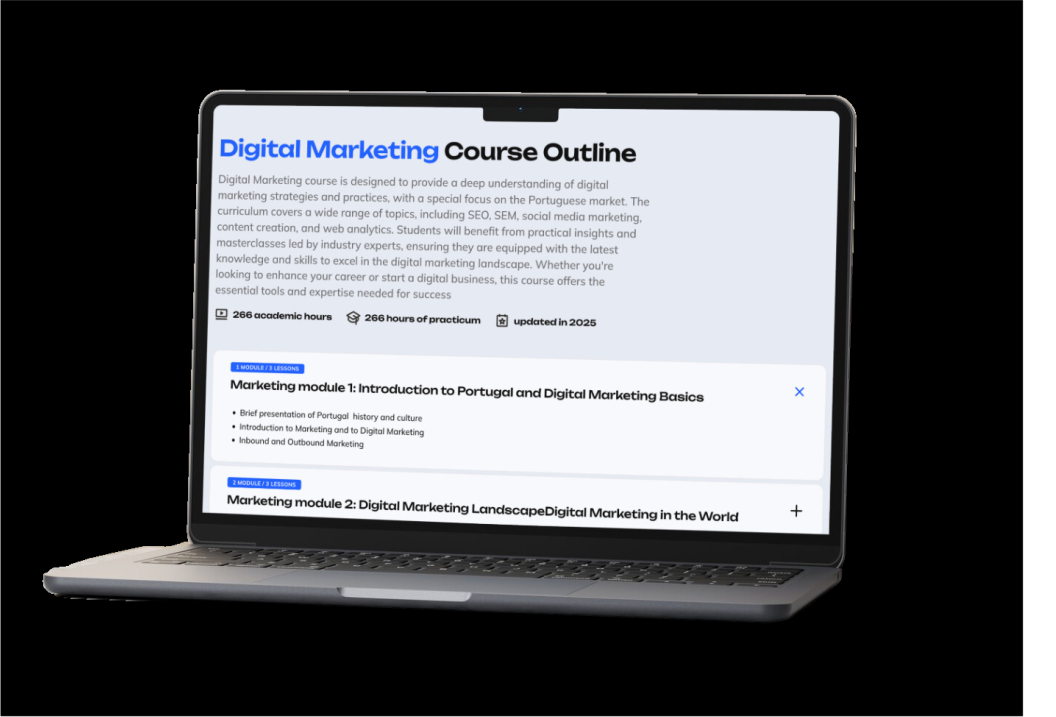
Making the jump from Central Europe to the Atlantic coast requires more than just a plane ticket; it requires a precise legal and educational strategy. For vocational training in 2026, the temporary stay route is the primary path. If you are ready to start your journey, explore our Digital Marketing programs or reach out to our team at Facultét to align your educational goals with Portuguese immigration requirements.
Data verified as of 2026-09-01.