Latvia to Portugal: Continuing Your Studies After Visa Expiry

Relocating from the Baltics to the Iberian Peninsula is a strategic move for many international students who find the Latvian labor market restrictive or the climate too harsh. By September 2026, the transition from a Latvian residency permit (TRP) to a Portuguese study authorization has become a standardized process, provided you navigate the post-SEF bureaucracy correctly. If your Latvian residence permit is nearing its expiration date, you cannot simply 'transfer' your visa. You are embarking on a new application process governed by Portuguese immigration law and AIMA (Agência para a Integração, Migrações e Asilo) regulations.
The Legal Framework for 2026
As of late 2026, Portugal has solidified its stance on legal migration pathways. The abolition of the 'Manifestation of Interest' (former articles 88.2 and 89.2) in 2024 means that students coming from Latvia must ensure they have a valid basis for staying before their Latvian permit expires. If you hold a valid Latvian TRP, you can enter Portugal under the Schengen 90/180-day rule to scout schools or attend interviews, but to stay long-term, you must secure a Portuguese visa at a consulate. For vocational training (DGERT), this is typically the E9 Temporary Stay Visa under Article 54(1)(k). We in Facultét often see students mistakenly believe that a Latvian permit grants an automatic right to work in Lisbon; this is not the case. Your legal status in Portugal is independent of your previous Latvian history.
Choosing a Professional Course (Cursos Profissionais)
For those who have completed a degree in Riga or Daugavpils and seek practical skills, DGERT-certified professional courses in Portugal are the primary vehicle for legal stay. Unlike traditional universities, these programs focus on immediate employability. Popular choices in 2026 include technical roles in the tech hubs of Porto and the Algarve. For instance, transitioning into Project Management allows you to leverage your previous academic background while gaining a qualification recognized by the Portuguese Ministry of Education. These courses typically last 1 to 2 years and provide the necessary documentation to apply for an E9 temporary stay visa.
Recognition of Prior Learning (Equivalência)
Portugal and Latvia are both EHEA members, which simplifies the recognition of ECTS credits. However, if you are moving from a Latvian high school or a non-degree program to a Portuguese professional school, you must undergo the 'Equivalência' process through the Directorate-General for Education (DGE). You will need your transcripts apostilled in Latvia. Note that in 2026, many Portuguese institutions require documents to be translated into Portuguese by a certified translator recognized by the Portuguese Consulate or a local notary. If your goal is a data-driven career, enrolling in Data Science - Machine Learning & AI can be done even if your previous studies were in a different field, provided you meet the entrance logic tests.
Financial Requirements and Subsistence
AIMA is strict about financial means in 2026. According to the current minimum wage updates (Salário Mínimo Nacional) for 2026, the base rate is €920 per month (paid 14 times a year), as confirmed by the Portuguese Government and Pordata. For a student visa, you generally need to prove you have 100% of the first year's minimum wage in a Portuguese bank account. This amounts to €12,880 (920 * 14). If you are staying with family or have a scholarship, these requirements can be adjusted, but having a NIF (Tax Identification Number) and a local bank account is mandatory before you file your application. Do not rely on Latvian bank statements alone; AIMA prefers to see the funds within the Portuguese financial system (Banco de Portugal regulations) to ensure local liquidity.
The Timeline for Transition
Timing is the most frequent point of failure for students moving from Latvia. You should start the process at least 4 months before your Latvian TRP expires. 1. Months 4-3: Select your DGERT-certified course and secure an enrollment letter (Carta de Aceitação). 2. Month 2: Secure a Portuguese NIF and open a bank account. 3. Month 1: Apply for the E9 temporary stay visa (Article 54(1)(k)) at a Portuguese consulate before your Latvian permit expires. Status change within Portugal for vocational courses is no longer possible under Article 92; you must obtain a visa abroad. 4. Post-Arrival: If your stay exceeds 120 days, ensure your E9 visa covers the full course duration (up to 1 year extendable).
Housing and Integration in 2026
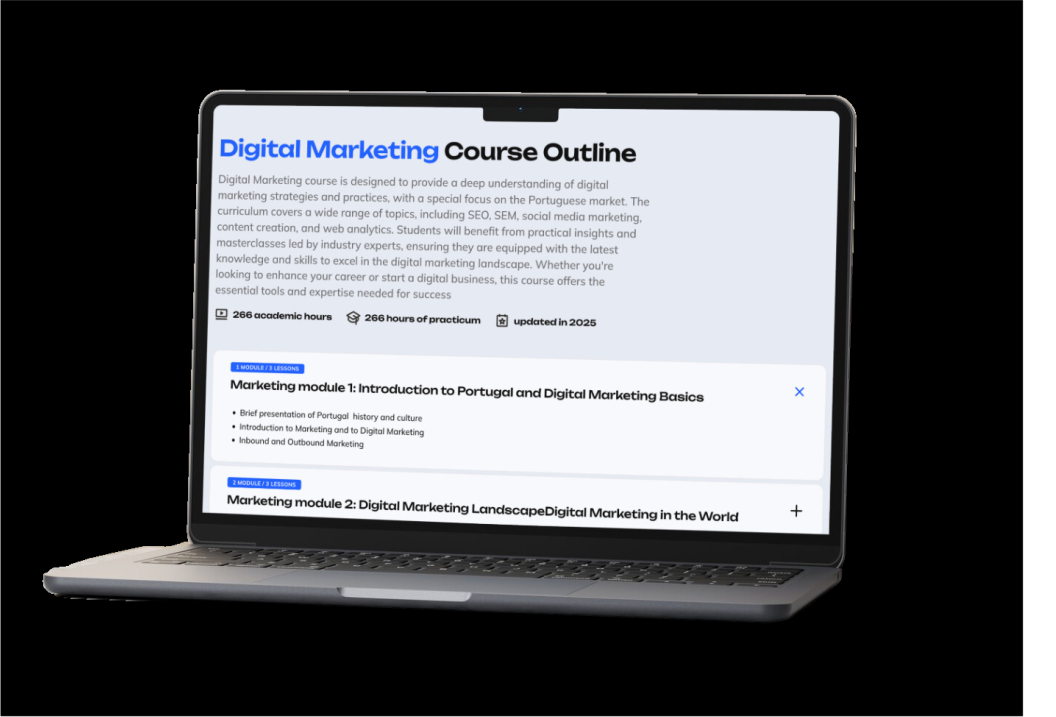
The housing crisis in Lisbon and Porto remains a significant hurdle in 2026. When moving from Latvia, expect significantly higher rents. A room in Arroios or Benfica now averages €550-€750 per month. You will need a formal rental agreement (Contrato de Arrendamento) registered with the Portal das Finanças to prove your address for the visa application. Without a registered contract or an 'Atestado de Residência' from the local Junta de Freguesia, the authorities will not approve your stay. If you are looking to specialize in the intersection of tech and business, a course in Digital Marketing can often be paired with remote study, providing more flexibility in where you choose to live within Portugal.
Frequently asked questions
Can I work in Portugal with a Latvian student visa?
No. Your Latvian student visa only allows you to visit Portugal for 90 days as a tourist. To stay long-term, you must obtain a Portuguese visa. Under September 2026 regulations, the E9 temporary stay visa for vocational courses does not grant the right to work in Portugal and does not lead to a residence permit.
What is the minimum bank balance required for a student visa in 2026?
Based on the €920 minimum wage (SMN 2026), you should show €12,880 for a one-year stay. This covers the annual total based on 14 payments required by Portuguese law, as verified by Pordata.
Is the Manifestation of Interest still an option?
Absolutely not. The Manifestation of Interest (Articles 88.2 and 89.2) was abolished in June 2024 by Lei n.º 37/2024. You must enter Portugal with the correct visa obtained at a consulate.
Do I need to speak Portuguese to study in a professional school?
While some international programs are in English, many DGERT-certified professional courses require a B1 level of Portuguese. However, tech-heavy courses like those at Facultét often utilize English materials, making the transition easier for international students from the Baltics.
Navigating the shift from Latvia to Portugal requires precision in documentation and a clear academic path. Whether you are aiming for a career in tech or management, ensuring your enrollment is DGERT-compliant is the first step toward a legal stay. If you are ready to secure your future in Portugal, explore our Project Management program or contact our admissions team for a detailed consultation on your specific case.
Data verified as of 2026-09-01.