From Poland to Portugal on a Student Visa: Step-by-Step Guide for 2026

Relocating from Poland to Portugal as an international student involves navigating a shifting regulatory landscape. As of September 2026, the transition requires more than just a valid Polish residence card (Karta Pobytu). Following the major 2026 reforms under the amendment to Lei 23/2007, Portugal has further restricted residence pathways, meaning students must now strictly follow pre-defined legal paths to secure their stay. Whether you are transferring from a university in Warsaw to a tech hub in Lisbon or pursuing specialized training in Porto, understanding the current AIMA (Agência para a Integração, Migrações e Asilo) requirements is paramount.
The Legal Framework for Intra-EU Mobility
If you hold a Polish student residence permit, you benefit from certain mobility rights under EU Directive 2016/801. However, this does not grant an automatic right to live in Portugal indefinitely. For stays exceeding 90 days, you must apply for a specific Portuguese visa or permit. In 2026, students moving from Poland typically take one of two routes: formal credit transfer for higher education or enrolling in DGERT-certified professional courses under a temporary stay visa. We in Facultét have observed that students who prepare their NIF and NISS early significantly reduce their administrative burden upon arrival.
Required Documentation for the Visa
To transition successfully, you must present a clean paper trail to the Portuguese consulate in Poland. The following documents are mandatory as of September 2026:
- Valid Passport and a Polish Karta Pobytu valid for at least 3 to 6 months beyond the application date.
- Proof of Enrollment: An acceptance letter from a Portuguese higher education institution or a DGERT-certified entity.
- Financial Sufficiency: Proof of funds equivalent to at least the national minimum wage (€920 per month, totaling €11,040 for a year) as verified by Banco de Portugal standards.
- Accommodation: A rental contract or a term of responsibility (Termo de Responsabilidade) from a host.
- Criminal Record: A certified translation of your Polish and home-country criminal records.
- Health Insurance: A valid PB4 form (if applicable) or private insurance with minimum €30,000 coverage.
The AIMA Appointment and Costs
Since the dissolution of SEF, AIMA manages all residency applications. In 2026, for those in higher education, the scheduling system is integrated with the digital transition portal. The administrative fee for a student residence permit (Art. 91) is approximately €170, though prices are subject to minor annual adjustments. Be aware that vocational training students under Article 54(1)(k) receive an E9 temporary stay visa, which allows a stay of up to one year but does not lead to a residence permit or count toward nationality. You must provide biometric data and will receive your documentation by mail.
Working While Studying in 2026
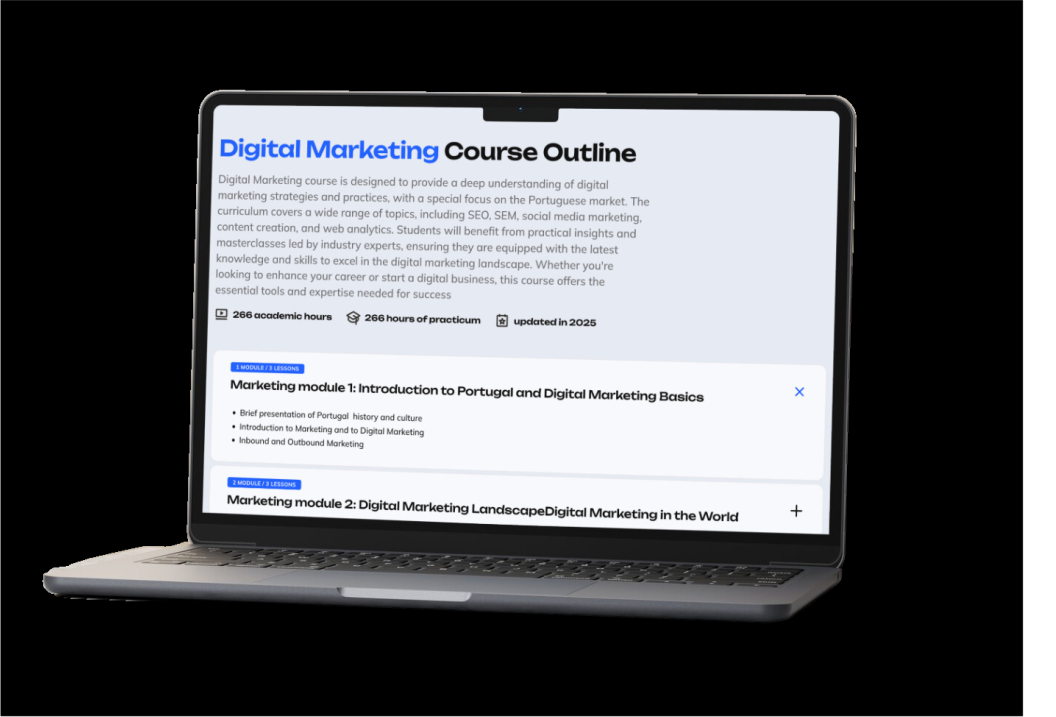
Portugal remains attractive for university students because of the work rights attached to the student residence permit. However, students on a temporary stay visa for vocational courses (E9 visa) carry no right to work. The national minimum wage is now €920, providing a baseline for part-time income for those eligible. For those looking to maximize their career potential, enrolling in a Project Management course or a technical program in Digital Marketing can bridge the gap between academic study and the high-demand tech sector, provided you hold the appropriate residence status.
Housing and Cost of Living
The 'Mais Habitação' package of 2023 continues to impact the market in 2026. While short-term rentals are restricted, student housing remains a challenge in major hubs. Expect to pay between €450 and €650 for a room in a shared apartment (quarto) in Lisbon or Porto. In smaller university towns like Coimbra or Covilhã, costs drop to €300-€400. You will need a NIF (Número de Identificação Fiscal) to sign any formal rental agreement. We recommend obtaining this via the Portal das Finanças immediately, as it is also required for opening a bank account and setting up utilities.
Academic Recognition and ECTS
Portugal adheres to the Bologna Process, meaning credits earned in Poland are generally transferable via the European Credit Transfer and Accumulation System (ECTS). However, for professional certifications, you must ensure the institution is DGERT-certified (Direção-Geral do Emprego e das Relações de Trabalho). If you are looking to specialize in data-driven fields, transitioning into a Data Science - Machine Learning & AI program is a strategic move, though students should note that under current Art. 92(4) revocation, vocational courses no longer lead to residency.
Frequently asked questions
Can I move to Portugal with only a Polish Schengen visa?
No. A Schengen visa allows for tourism up to 90 days. For residency or long-term study, you must apply for a residence visa (D4) or a temporary stay visa (E9) at a consulate abroad before arrival.
What is the minimum bank balance required for 2026?
AIMA/Consulates require proof of €920 per month (minimum wage for 2026) for the duration of your stay. For a one-year stay, you should show a minimum of €11,040 in a bank account, preferably a Portuguese one.
How long does the student residence card last?
For higher education, the initial card is typically valid for two years. For vocational training, students receive a temporary stay visa valid for the duration of the course up to one year, which cannot be converted into a residence permit.
Is the NHR tax status still available for students who start working?
The original NHR is closed. However, if you transition into a high-value profession after graduation, you may qualify for the IFICI (Tax Incentive for Scientific Research and Innovation), often called 'NHR 2.0', which offers specific tax benefits for 10 years as per Decree-Law 139/2023 and 2026 updates.
Do I need to speak Portuguese to get a student visa?
For the visa itself, no. However, for undergraduate programs, universities usually require B2 Portuguese. Many Master's and professional IT courses are taught in English, making them accessible to international students from Poland.
Transitioning from Poland to Portugal requires precise timing and a deep understanding of current AIMA protocols. If you are ready to upgrade your skill set, explore our professional certifications or contact our advisors at Facultét today to map out your academic strategy for 2026.
Data verified as of 2026-09-01.