Diploma in Portugal for International Students: How to Choose the Right Qualification

A diploma in Portugal is not one single type of qualification. For international students, the important question is what the programme actually awards: an academic degree, a higher professional diploma or a vocational training certificate. These documents serve different purposes and are not automatically interchangeable.
If you are comparing courses from abroad, start with the qualification rather than the word “diploma” in an advertisement. This guide explains the main distinctions, what to ask an institution and how to decide whether a practical course fits your goals.
Information checked on 14 November 2026. Course availability may change. This article is educational information, not individual immigration or qualification-recognition advice.
What does “diploma in Portugal” mean?
In English, diploma can mean both an award and the document confirming it. Portuguese institutions may use terms such as grau académico, diploma and certificado de formação. The exact wording matters: a training certificate does not become a university degree because its English description calls it a diploma.
Portugal has university and polytechnic education, alongside other forms of education and professional training. The official qualifications framework published by DGES distinguishes qualification levels. Ask for the award’s full Portuguese name and its formal level, if one is assigned.
Academic degrees
If your goal is a bachelor’s or master’s degree, select a recognised higher education programme leading to that specific academic award. Check the institution, entry requirements and programme registration through the official Portuguese higher education network and training-offer information. Do not assume a private professional course offers the same award.
Higher professional diplomas: CTeSP
A Curso Técnico Superior Profissional is a specific higher professional programme, not a general label for any short course. DGES describes CTeSP programmes as four curricular semesters and 120 ECTS, including an internship. They award a Técnico Superior Profissional diploma, not an academic degree.
This distinction is especially useful if an advertisement describes a one-year course as equivalent to a Portuguese higher professional diploma. Ask for evidence of that equivalence instead of relying on the course’s duration or name.
Vocational and continuing-training certificates
Professional training may be appropriate when your priority is practical skills, career exploration or a structured portfolio. Its value depends on the curriculum, assessment, teaching and the precise certificate awarded. It should not be presented as automatically equivalent to a degree, a CTeSP diploma or a national qualification level.
DGERT certification concerns training providers and their certified areas. Read our guide to checking DGERT certification in Portugal before treating a logo as proof of a particular qualification.
How international students should compare programmes
- Define the outcome. Do you need a degree for postgraduate entry, a specific qualification for a regulated profession, or practical training for a career change?
- Check the award. Request its exact name, issuing organisation and any formally assigned level. Ask whether the programme grants academic credits.
- Confirm the teaching language. An English website does not prove every lesson, assessment or administrative document is available in English.
- Review the timetable. Check calendar length, contact hours, independent work and compulsory attendance. A blended programme is not necessarily fully remote.
- Inspect assessment. Ask what you must complete to receive the certificate and whether you can review examples of the expected project work.
- Read financial terms. Obtain a written total, a list of additional charges and cancellation terms before paying.
Admission documents: ask for a programme-specific list
Requirements vary by institution and qualification. Ask whether you need identification, evidence of previous education, a language assessment, a CV or an interview. If foreign educational documents are required, confirm whether translations, legalisation or formal recognition are necessary for this particular application.
Do not order expensive document services based on a generic online checklist. A university admission process and an adult professional-training application can have different requirements. Get the institution’s written instructions first.
Will a Portuguese diploma be recognised abroad?
There is no universal yes-or-no answer. Recognition depends on the award, the destination country and your purpose. An employer considering a skills certificate has a different task from a university assessing entry to a master’s programme or a regulator licensing a professional.
Keep a copy of the syllabus, assessment record, training hours and certificate. If recognition is essential, ask the receiving institution or competent authority before enrolling. Do not interpret “recognised training provider” as a promise that every employer or university worldwide will accept the award.
Study plans and immigration status are separate
A course offer is not permission to enter, reside or work in Portugal. Under the project’s current legal guidance, Lei n.º 62/2026 was published on 10 September 2026 and entered into force on 11 September 2026. Article 92(4) was revoked: vocational or DGERT training alone does not lead to a Portuguese residence permit or in-country legalisation.
Read the Foreigners Law update for vocational-course students and check your individual situation with the competent authorities or a qualified adviser. Do not infer work rights from enrolment.
A practical option to explore at Facultét
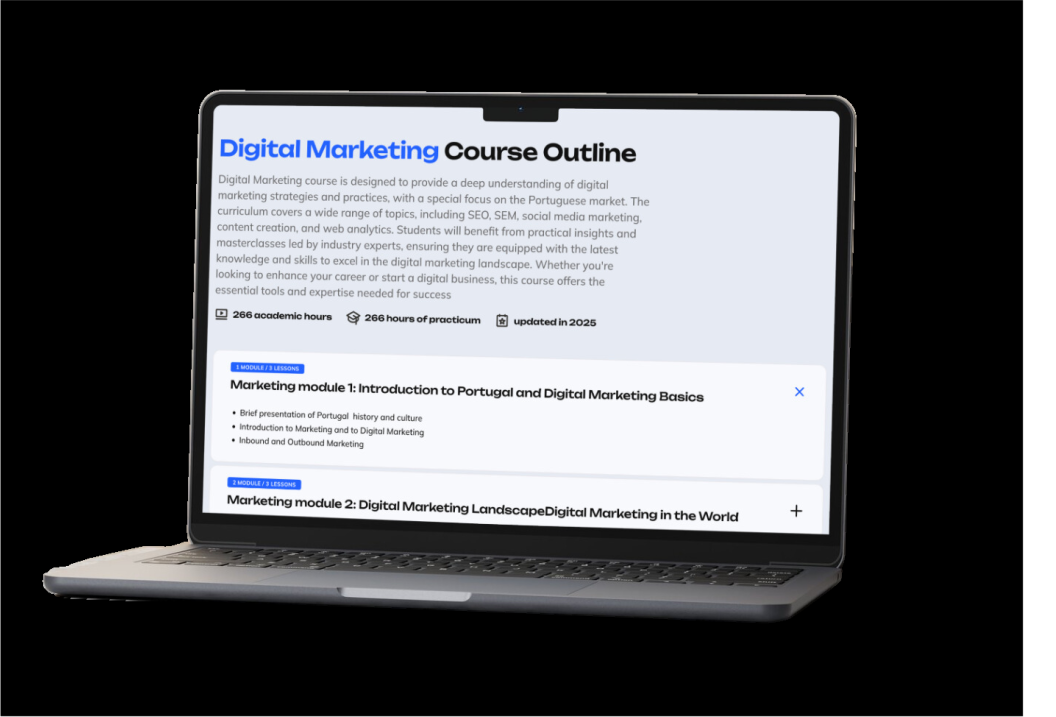
If you want professional training rather than an academic degree, review Facultét’s Digital Marketing programme. As checked on 14 November 2026, it is taught in English, lasts 11.5 months and lists a blend of 40% offline and 60% online learning. The Lisbon intake is listed for 15 March 2027. Confirm current availability and the exact completion award with the school.
For the time-commitment comparison, continue to our guide to one-year diploma-course searches in Portugal.
Frequently asked questions
Can international students apply for a diploma course in Portugal?
They can explore programmes accepting international applicants, but admission conditions are specific to the institution and award. Admission and lawful immigration status are separate checks.
Is a professional training certificate the same as a university diploma?
No. Compare the exact qualification awarded, not just the English word diploma. A vocational certificate is not automatically an academic degree.
Are diploma courses in Portugal taught in English?
Some programmes are taught in English; others are not. Confirm the language of classes, assessments and learner support directly with the provider.
Does enrolling in a DGERT programme give me residence or work rights?
No. Vocational training alone does not lead to residence, and enrolment itself does not grant a right to work. Your legal status must be assessed separately.