Changing Careers in Portugal: How Your DGERT-Certified Course Simplifies SEF/AIMA Legalization

Converting a residence permit for study into a full work authorization is the most critical hurdle for expats settling in Lisbon, Porto, or the Algarve. Under Article 89 or 92 of the Foreigners Law, transitioning from a temporary stay to a residence permit for subordinate work or independent activity is a paper-heavy marathon. The bureaucratic handoff from the now-defunct SEF to AIMA (Agência para a Integração, Migrações e Asilo) hasn't erased the underlying requirement: you must demonstrate professional viability and integration. Using a DGERT-certified qualification isn't just about learning; it is about building a legal file that AIMA officers cannot ignore.
The Mechanics of Transition: Artigo 88 vs. Artigo 90
Most students assume the change of status student to work permit Portugal is an automatic right once a contract is signed. It isn't. When moving from a student visa (Artigo 91) to a work permit (Artigo 88 for employees or Artigo 89 for freelancers/Recibos Verdes), the burden of proof is on you. If you are shifting from a non-tech background into the local digital economy, AIMA looks for formal evidence of your skills. This is where we at Facultét see the biggest success rates: students who pair their work contract with a certificate from a DGERT-certified entity. This accreditation tells the Portuguese state that your training meets national quality standards, making your transition from a language student or Master's candidate to a Project Management professional look legitimate and planned.
Why DGERT Certification Matters for Legalization
DGERT (Direção-Geral do Emprego e das Relações de Trabalho) is the gold standard for vocational training in Portugal. When you apply for a change of status, your dossier needs to prove "professional competence." A random online certificate from a non-Portuguese platform rarely carries weight with AIMA inspectors in locations like the Loja do Cidadão in Laranjeiras. However, a DGERT-certified course is recognized by the Ministry of Labor. If you are pivoting into the tech sector, presenting a diploma in Data Science: Machine Learning, Artificial Intelligence & Marketing Analytics demonstrates that you have local skin in the game. It proves you aren't just looking for any job to stay in the country, but are contributing to Portugal's high-value economy.
Step-by-Step Change of Status Checklist
1. Secure a formal job contract (contrato de trabalho). Note that the old "expression of interest" route (Manifestação de Interesse, Artigo 88.2 / 89.2) was abolished by Lei 9/2024 in June 2024 and is no longer available — as a student you change status on the basis of your valid residence card plus a registered employment contract under Artigo 88.1. Ensure the salary meets the national minimum (currently €920 per month, though aiming for €1,000+ is safer for approval).
2. Update your NIF and NISS. Your NIF (Número de Identificação Fiscal) must have a Portuguese fiscal address. Your NISS (Social Security) must show consistent monthly contributions.
3. Document your Education. If your degree is from abroad, you need recognition from a Portuguese university. If you are changing fields, your DGERT-certified training, such as Digital Marketing, serves as the vocational bridge that justifies your new job role.
4. Proof of Accommodation. A registered rental contract (Contrato de Arrendamento) at the Finanças is mandatory. A simple letter from a friend won't suffice for a permanent work permit.
The Freelancer Path: Artigo 89
For those choosing to open 'Atividade' as freelancers, the change of status student to work permit Portugal involves showing a consistent client base. If you are working as a remote consultant in Lisbon's Hub Criativo do Beato, you need to prove your skills are in demand. Many of our students at Facultét use their training in Data Science - Machine Learning & AI to secure high-ticket B2B contracts. When the AIMA officer sees that your NIF is generating invoices based on specific, certified technical skills, the risk of rejection for "lack of means of subsistence" drops significantly.
Timing and the 90-Day Rule
Never wait for your student residence card to expire before starting the change of status. Portugal's administrative backlog means appointments can take months. We recommend starting the skill-building and job search phase at least 150 days before your current card expires. By the time you sit in front of an officer in Porto or Coimbra, you should have at least three months of Social Security contributions and your DGERT certificate in hand. This proactive approach turns a stressful legal hurdle into a mere formality.
Frequently asked questions
Can I work on a student visa while waiting for my work permit?
Yes, but with limitations. Student visa holders can work up to 20 hours per week during term time and full-time during holidays. However, once you file for a change of status (Manifestação de Interesse), you are technically in a transitional state and should maintain your Social Security payments to ensure no gaps in your residency count.
How long does the change from student to work permit take?
The timeline varies wildly based on the AIMA branch. While the digital portal promises faster processing, expect 6 to 18 months for the final residence card to arrive. Staying enrolled in certified training during this time helps maintain your legal status and keeps your skills sharp for the local market.
Is a DGERT certificate mandatory for AIMA?
It is not legally mandatory, but it is highly strategic. For those moving into a new industry, like Data Science for Marketing, it provides the 'proof of qualification' required by the Labor Code and immigration officers who scrutinize whether your job offer matches your profile.
Do I need to leave Portugal to change my visa status?
No. Under the current legal framework, you can apply for a change of status (Artigo 88 or 89) directly within Portugal as long as you entered the countrly legally and have a valid student permit or are within the 90-day visa-free window (for certain nationalities).
What is the minimum salary required for a work permit?
At a minimum, you must earn the Portuguese national minimum wage (€920 in 2026). However, for professional roles, AIMA prefers to see contracts that reflect market rates for your specific qualification, which is why having a specialized certification is beneficial for salary negotiations.
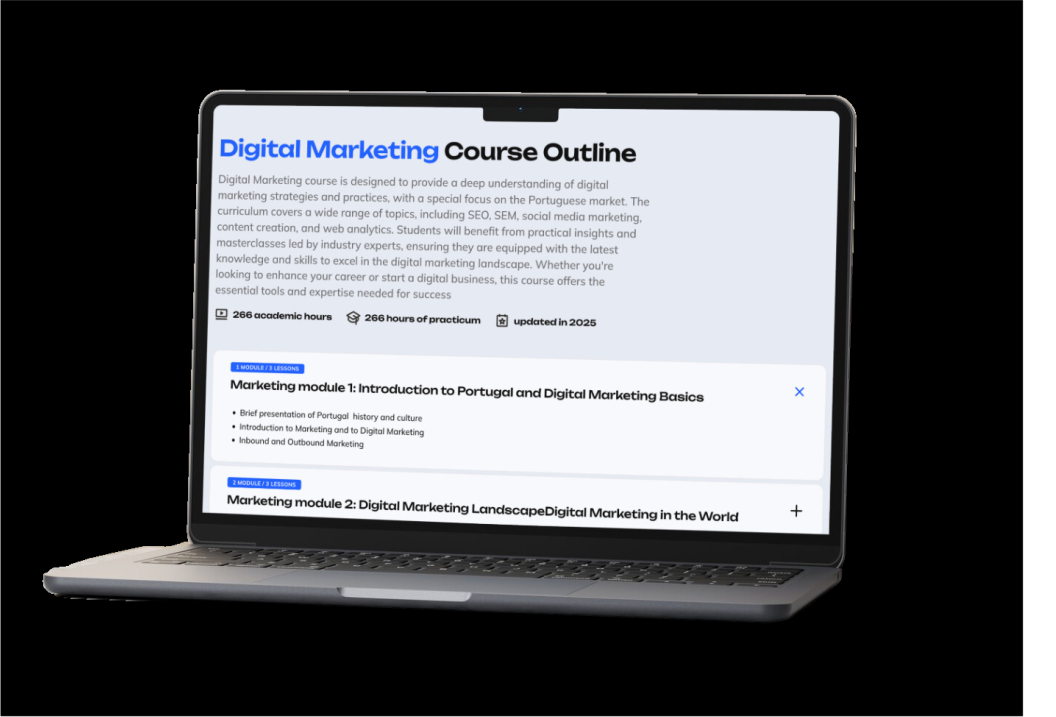
The path to legal residency in Portugal is a strategic game of documentation. Don't leave your future to chance or a generic job contract. If you are ready to secure your status and pivot into a high-demand career, exploration is your first step. Check out our Digital Marketing program or contact the Facultét team to learn how our DGERT-certified training can anchor your AIMA application and help you thrive in the Portuguese job market.